U.S. monitoring China’s maritime presence off Alaska
Sentry
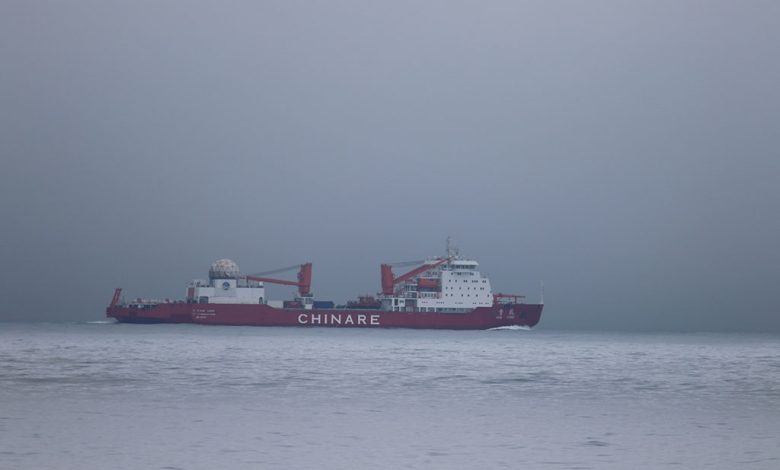
The United States Coast Guard tracked four Chinese Communist Party (CCP) research vessels in international waters off Alaska in September 2026 amid indications that Beijing is increasing its Arctic presence. In 2025, five CCP ships conducted work in the region, according to U.S. Coast Guard Rear Adm. Bob Little, who commands the service’s Arctic District.
“Where I have responsibility, interest and concern is when they are operating in and around U.S. sovereign space,” Little told the Reuters news agency during a visit to Oslo, Norway, to speak at an Arctic security conference. “So inside of our exclusive economic zones or over our extended continental shelf, we certainly have a security concern.”
In 2025, CCP ships spent time over the U.S.’s extended continental shelf and, for the first time, launched crewed submersibles beneath the Arctic Ocean ice, according to maritime news website gCaptain. In 2026, Beijing’s vessels sailed near the Aleutian Islands, into the Bering Strait and as far north as the North Pole. Although the ships remained in international waters, China did not notify the U.S. in advance of their presence through diplomatic channels, which is normal practice.
“When we challenge them … as to the purpose of their activities, their response typically is either ‘we are conducting operations in international waters’ or ‘we are conducting scientific research,’” Little said.
He said the U.S. has two main concerns: that the CCP may be conducting scientific research aimed at mineral exploitation in areas belonging to the U.S., and that the vessels could conduct activities providing the People’s Liberation Army (PLA) with military intelligence or posing other security threats.
China, despite being almost 1,300 kilometers from the Arctic Circle, calls itself a “near-Arctic state.” Its increased presence in the region includes coast guard patrols with Russia, exploratory projects in Arctic towns and the first regular cargo service to use the Northern Sea Route, which is a shortcut from Asia to Europe.
Beijing has the world’s largest fleet of civilian research vessels and uses them to advance strategic ambitions in a region whose sea floor contains valuable mineral and energy deposits, according to the Center for Strategic and International Studies, a U.S.-based think tank. The ships use a three-dimensional approach to collecting Arctic data that involves land-based, maritime and air/space research, The Diplomat magazine reported in June 2026. That data can be shared with the PLA, which describes the Arctic as a crossroads of aviation and maritime power projection — a “strategic commanding height” over the Northern Hemisphere, according to The Diplomat.
U.S. analysts say the data gathered by CCP submersibles in the Arctic supports more than Beijing’s stated claims of climate analysis, The Wall Street Journal reported in December 2025. Military experts say the information is used to build computer models that help Beijing’s “relatively noisy submarines” avoid detection, according to the newspaper. That is especially important in the Arctic, where sea ice impedes airborne submarine detection that works in other oceans.
“China aims to take the lead in marine and climate science because understanding the ocean and the climate is a critical enabler to success in naval operations, particularly in anti-submarine warfare,” Hunter Stires, a naval strategist and former advisor to the U.S. Navy secretary, told the newspaper.
Sentry is a professional military magazine published by U.S. Strategic Command to provide a forum for national security personnel.