U.S. announces space weapons deployment
Sentry
United States military leaders emphasized the strategic importance of deterrence in space as they said the nation has deployed orbital weapons.
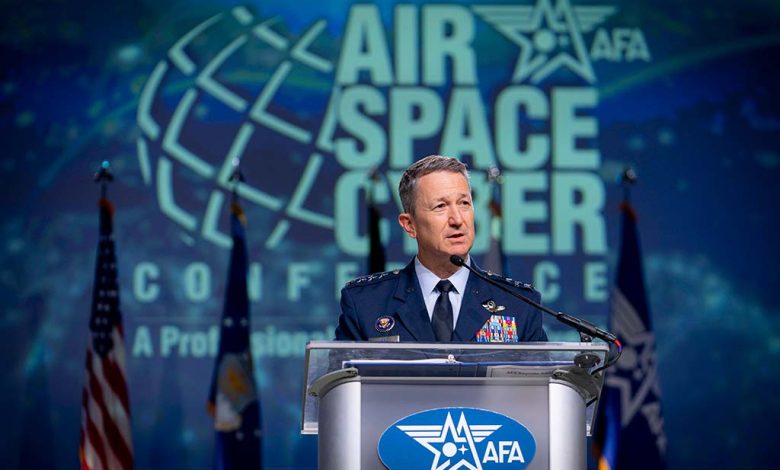
At the annual Air, Space and Cyber Conference in September 2026 in Maryland, U.S. Air Force Gen. Dan Caine, chairman of the Joint Chiefs of Staff, said the military must be ready to “fight, endure and win … from the seabed to cislunar space,” according to The Associated Press (AP). Cislunar space is the region between Earth and the moon.
U.S. Secretary of the Air Force Troy Meink, who oversees the U.S. Air Force and U.S. Space Force, said preparations already have begun.
“Today, we continue to ensure we remain ready to meet the challenges of evolving threats wherever they exist. This is why the United States now has on-orbit space-control weapons capable of defending the joint force against hostile adversary action,” Meink told the conference, according to Air & Space Forces Magazine.
His comments came a month after U.S. Space Force Gen. Stephen Whiting, commander of U.S. Space Command, called the acquisition of anti-satellite weapons (ASAT) vital to deterrence. “To win, we need credible, acknowledged, kinetic and nonkinetic fires,” Whiting said, according to the website The War Zone.
Kinetic refers to traditional weapons that physically engage targets such as missiles; nonkinetic systems can include capabilities such as electronic or cyber warfare. “They are a key component of how we establish space superiority and restore credible deterrence,” Whiting said.
To that end, Meink said it is important to discuss the existence of U.S. space-control weapons to establish deterrence. “We’re not going to talk about the specifics of what we’re doing, whether we’ve tested it, not tested it, or anything else,” he said, according to the technology website Ars Technica. Space control refers to actions to protect U.S. and allied space forces and offensive actions to negate an adversary’s space capabilities.
China and Russia view space as a warfighting domain through which to deny the U.S. information advantage, the U.S. Space Force says. Both nations have ASAT missiles, are testing orbital ASAT systems, and deploy other kinetic and nonkinetic capabilities.
In 2024, U.S. officials reported that Moscow intended to develop a nuclear-armed space weapon. A nuclear detonation in low Earth orbit could instantly destroy or damage thousands of satellites and cripple global positioning, navigation and timing systems — the infrastructure critical for communications, financial transactions, transportation and other services globally.
The international 1967 Outer Space Treaty bans weapons of mass destruction but does not restrict deployment of conventional weaponry.
The use of kinetic weapons in space would create debris that jeopardizes satellites. The U.S. favors space weapons that do not produce debris, according to Ars Technica.
Meink also said the U.S. Space Force has achieved “flight ready” hardware for space-based interceptors that can down enemy missiles from orbit, which is a centerpiece of the Department of War’s Golden Dome initiative.
“It is critically important that we maintain our dominance, not only in the air but in space,” he said. “So, we’ve had to take steps to make sure that when we’re threatened, we can take care of that.”
Sentry is a professional military magazine published by U.S. Strategic Command to provide a forum for national security personnel.