India, Indonesia, Japan exploring trilateral defense framework
Mandeep Singh
India, Indonesia and Japan are setting the foundation for a trilateral defense framework, another sign of a regional shift toward flexible minilateral security arrangements that operate alongside existing alliance structures.
The move gained momentum with the August 2026 meeting between Indian Defence Minister Rajnath Singh and Japanese Defense Minister Shinjiro Koizumi in India, which followed Japanese Prime Minister Sanae Takaichi’s visit to India the previous month. Koizumi said he and Singh discussed rapidly increasing defense cooperation under the Free and Open Indo-Pacific vision and agreed that their nations should promote trilateral cooperation with Indonesia.
Analysts say a trilateral framework would combine complementary strengths: Japan’s advanced defense technology, India’s expanding industrial base, and Indonesia’s location along vital maritime choke points, including the Malacca and Sunda straits.
Growing cooperation among the nations includes their inaugural naval exercise in the Andaman Sea near the Malacca Strait in February 2026, a $600 million defense package signed in July 2026 between Jakarta and New Delhi featuring Indian-made BrahMos supersonic cruise missiles, and Japan’s first deployment of fighter jets to India in September 2026 for Exercise Veer Guardian.
“Japan and India have signaled that they are open to exporting the hardware Indonesia needs, with Japan offering advanced destroyers and India its BrahMos missiles,” Dharma Agastia, an associate professor at Hiroshima University’s Research Institute for Ocean and Maritime Futures, told FORUM. He noted that Jakarta is diversifying its defense partnerships as it modernizes its military.
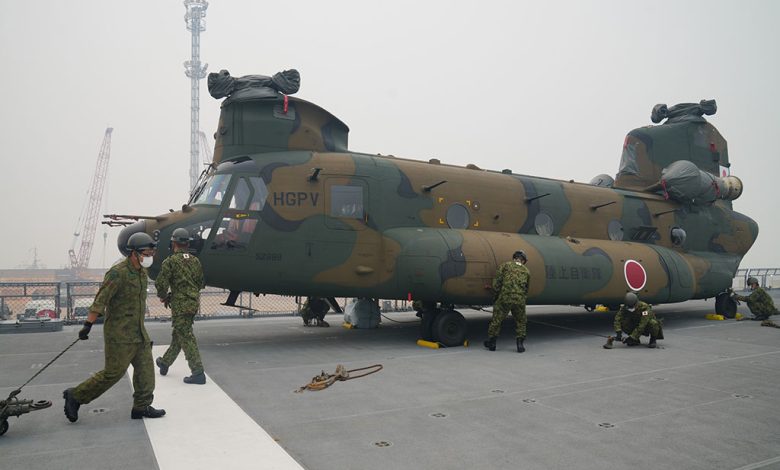
Agastia said humanitarian assistance and disaster response is a potential area of trilateral cooperation, citing the deployment of Japan Self-Defense Forces personnel and assets to fight forest fires in Indonesia’s Kalimantan region in September 2026. Similarly, the Andaman Sea drills could pave the way for routine trilateral naval exercises.
— STORY CONTINUES BELOW —
Join the discussion
How do your armed forces work with Allies and Partners to enhance regional security?
During their meeting, Koizumi and Singh noted the landmark maritime drills with Indonesia, according to a joint statement. “With a view to taking a comprehensive perspective of the Indo-Pacific and contributing jointly to peace and stability in the region and the world, they concurred on further deepening cooperation with third countries, through high level exchanges, exercises and other relevant initiatives.”
The emerging trilateral partnership reflects an increasing preference for such cooperation over a single overarching security architecture, Rajeswari Pillai Rajagopalan, a resident senior fellow with the Australian Strategic Policy Institute, told FORUM.
Indonesia, which hosted the multinational Super Garuda Shield exercise in August and September 2026, is expanding its defense ties with the United States and other partners while maintaining its “free and active” foreign policy. Jakarta wants to ensure the continued centrality of the 11-member Association of Southeast Asian Nations, of which it is a founder, according to Agastia and Rajagopalan.
For now, Jakarta, New Delhi and Tokyo are building their relationship through joint exercises, technology transfers and maritime domain awareness initiatives, adding further flexibility to the Indo-Pacific security architecture.
Mandeep Singh is a FORUM contributor reporting from New Delhi, India.