Counterattack
Allies and Partners integrate defensive systems to combat drones
FORUM Staff
Acceleration and affordability are key pillars of the uncrewed aerial vehicle (UAV) strategy for the United States and its Allies and Partners in the Indo-Pacific.
The U.S. amplified the strategy when Secretary of War Pete Hegseth created the Joint Interagency Task Force (JIATF) 401 in August 2025 to rapidly acquire and integrate defense systems to combat small UAVs. The counter-uncrewed aerial systems (C-UAS) capability targets drones lighter than 590 kilograms.
“The main measure of effectiveness we have … is to ensure rapid delivery of state-of-the-art, innovative capabilities into warfighters’ hands to increase the lethality,” U.S. Army Lt. Col. Paul Lushenko, the task force’s chief strategist, said during a December 2025 War Room podcast from the U.S. Army College.
Four months after Hegseth’s announcement, the U.S. Central Command (USCENTCOM) launched Task Force Scorpion Strike to deliver efficient and economical autonomous systems. Its first squadron of low-cost uncrewed combat attack systems (LUCAS) is based in the Middle East. The LUCAS is derived from reverse engineering Iranian Shahed-136 technology — the drone Tehran has deployed against Israel and Russia has used against Ukraine. “Equipping our skilled warfighters faster with cutting-edge drone capabilities showcases U.S. military innovation and strength, which deters bad actors,” said U.S. Navy Adm. Brad Cooper, USCENTCOM commander.
The LUCAS can be launched from catapults, rockets, vehicles or the ground. The UAV is about 3 meters long with a 2.5-meter wingspan and its delta-wing design allows for long-range loitering. The U.S. deployed LUCAS operationally for the first time in the initial stages of the Operation Epic Fury conflict with Iran that began in February 2026.
The Department of War said in late 2025 that it wants to deploy over 300,000 small attack drones. The $1 billion initiative, known as Drone Dominance, aims to have tens of thousands of autonomous aerial vehicles in the hands of service members in 2026 with hundreds of thousands available in 2027.
UAVs mark the intersection of trends in military technology — the precise nature of weapons and the rise of robotics allowing remote-control drones capable of delivering a lethal payload with no risk to a pilot, the Australian Army Research Centre noted in August 2024. UAVs have altered the dynamics of military operations, offering tactical advantages and enhanced operational efficiency. They can be used for surveillance, reconnaissance and targeted strikes.
“The corollary to the importance of armies fielding UAS is that effective, layered and efficient counter-UAS capabilities are neither a luxury nor a concept to be explored as part of an abstract future force. They are a basic requirement for a land force to be suitable for operations on the modern battlefield,” said the 2024 study “Protecting the Force from Uncrewed Aerial Systems,” published by the Royal United Services Institute for Defence and Security Studies, a London-based think tank. “Without C-UAS capabilities, a force will be seen first, engaged more accurately, and ultimately defeated by an opposing force that successfully fields UAS and C-UAS capabilities at scale.”
Countering UAVs requires layered defenses, including radar, radio frequency sensors, cameras, acoustic detectors, lasers and potentially nets to capture drones and protect sensitive areas, infrastructure and personnel. Nonkinetic tools, called soft-kills, include jamming, spoofing and signal takeover to disrupt navigation systems and disable UAVs. Kinetic, or hard-kill, tools include gun-based systems, interceptors and directed energy weapons such as lasers or high-power microwaves to destroy UAVs.
“The worst drone threat is the one you don’t detect,” Oleksandra Molloy, a senior lecturer in aviation at the University of New South Wales in Sydney, Australia, told FORUM. “The question is no longer just which counter-drone system Indo-Pacific countries should acquire but how quickly [they] can establish the commercial and military partnerships to rapidly and effectively keep up with the changing threat.”
Lessons from Ukraine
Drone technology has revolutionized warfighting since the Russia-Ukraine war began in February 2022. Both countries’ tactics include the widespread use of small UAS and C-UAS weapons. “It is a tactical and technological inflection point,” the Hudson Institute, a U.S.-based think tank, said in November 2025. “The war’s defining feature has become the mass deployment of cheap, disposable, and networked technologies — especially drones, loitering munitions, and small-scale electromagnetic warfare systems.”
Mass production is vital. Ukraine’s Defense Ministry said in September 2025 that more than 1 million drones were delivered to military units over the first eight months of the year with millions more expected in early 2026.
Ukraine also changed acquisition procedures and allowed front-line commanders to obtain drones directly from manufacturers, sometimes within five days, according to Defense One, a U.S.-based publication.
The U.S. approach is similar to what the Ukrainians have done, Emil Michael, U.S. undersecretary of war for research and development, said at an August 2025 forum in Washington, D.C. “They push down the innovation to a very small unit level. They’ve competed them on which drones work better. Then they give more financing to the ones that work better. So that’s their model. Our model is going to be: Bring it down to the unit level, reduce the barriers, provide broad training grounds.”

Attack drones upended the economics of war. In June 2025, Ukraine said it used more than 100 remotely piloted drones to strike five Russian air bases, hitting 41 aircraft, including strategic bombers, and causing damage estimated at $7 billion. Kyiv also has successfully deployed naval drones — surface and underwater vessels equipped with anti-ship missiles. Ukraine’s maritime drones premiered in October 2022 when nine drones attacked Russia’s Black Sea fleet in the Crimean port city of Sevastopol. Even without a conventional naval fleet, Kyiv pushed Russian forces out of the western Black Sea, destroying about 20 vessels in a display of an effective asymmetric tool in contested waters, the Hudson Institute said.
In December 2025, Ukraine used an underwater attack drone to penetrate the Russian defenses at Novorossiysk naval base on the Black Sea and to disable a submarine. The submarine had attacked Ukraine’s critical infrastructure and energy grid, according to The National Interest, a U.S.-based publication.
Affordability issues
Countering UAVs can be expensive without investing in technology. Between November 2023 and January 2025, the U.S. Navy defeated 380 Houthi rebel attack drones and ballistic and cruise missiles in the Red Sea by firing more than 160 artillery rounds and 200 missiles, including 20 SM-3 missiles that each cost up to $28 million, Stars and Stripes newspaper reported. The U.S. expenditures also included 120 SM-2s worth more than $2 million each and 60 SM-6s at about $4 million apiece.
“We cannot afford to shoot down cheap drones with $2 million missiles and we ourselves must be able to field large quantities of capable attack drones,” Hegseth said in announcing the Drone Dominance initiative.
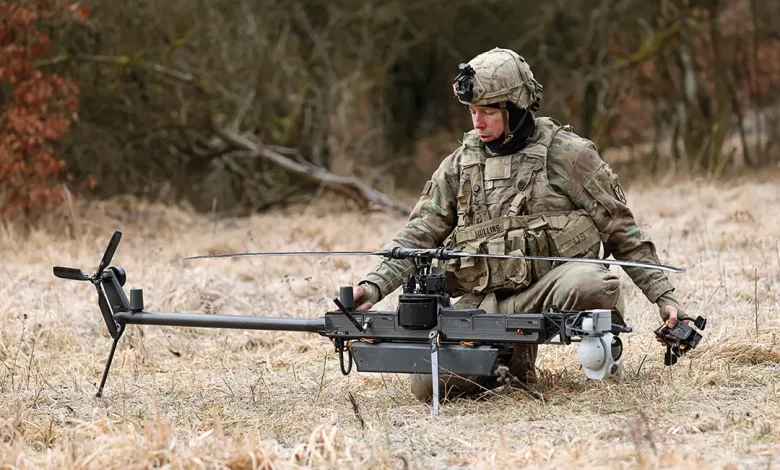
The artificial intelligence (AI)-enabled Merops interceptor drone, used by Poland, Romania and Ukraine to detect and destroy small UAVs, costs about $15,000. That is half the cost of the Iranian-designed Shahed drone used by Russian forces against Ukraine, Defense One reported. Polish, Romanian and U.S. Soldiers trained on the Merops system in November 2025.
“It can defeat the Shahed-type threats, but also it demonstrates our ability to place capabilities that are much cheaper than some of our other previous systems … to ensure that we are able to build the capacity against” future airborne drone threats, said U.S. Army Brig. Gen. Curtis King, commanding general of the 10th Army Air and Missile Defense Command in Germany.
The C-UAS and accompanying offensive systems will support Allies and Partners, said U.S. Army Col. Christopher Hill, senior director of the Global Tactical Edge Acquisition Directorate. The next steps are to develop autonomous air- or ground-launched systems as “the offensive systems that we’re going to use to create a dilemma for our adversaries,” Hill said. “We’re going to replicate the same processes there in the Pacific region in order to not only support our U.S. unit there, but also our international partners in Australia, in South Korea and in Japan, and other partners there in the region.”
The U.S. military has tested expanding its drone operations in the Western Pacific, including Airmen, Marines and Sailors deploying UAVs across Japan. In October 2025, an MQ-9 Reaper launched and landed without a runway at Kadena Air Base, Japan. Kadena is 595 kilometers from Taiwan, making it the closest U.S. air base to the self-governed island.
Allies and Partners counter drones
Indo-Pacific nations are innovating to address the drone threat, said Molloy, including devising layered shields “so hostile drones could be jammed, shot with high-powered microwaves or lasered out of the sky before they pose a threat.”
Japan is investing in laser-based counter systems such as a prototype that uses an infrared camera to detect targets. In late 2025, Tokyo demonstrated a 100-kilowatt laser system that can burn through metal and shoot down small UAVs.
Taiwan, meanwhile, is seeking to establish an international drone alliance, the Taipei Times newspaper reported. The government-backed Taiwan Excellence Drone International Business Opportunities Alliance and the Polish Chamber of Unmanned Systems signed an agreement in December 2025 to develop a “non-China” supply chain for drones and to collaborate on key technologies, Taiwan Foreign Affairs Minister Lin Chia-lung said. The effort will give Taiwan and partners an advantage in talent, technology, applying AI and funding, he said.
Taiwan’s Defense Ministry also announced a $312 million initiative to acquire 635 lightweight counter-drone systems capable of assuming control over, jamming and data spoofing hostile UAVs. Taipei also is exploring autonomous maritime vessels.
“Uncrewed boats or vehicles have played a very significant role in the Ukraine war,” Chen Kuan-ting, who serves on the Taiwan parliament’s defense committee, told the Reuters news service. “Uncrewed vehicles, whether they are boats or underwater vehicles, can effectively deter China because Taiwan is not the attacking side, we are the defending side.”
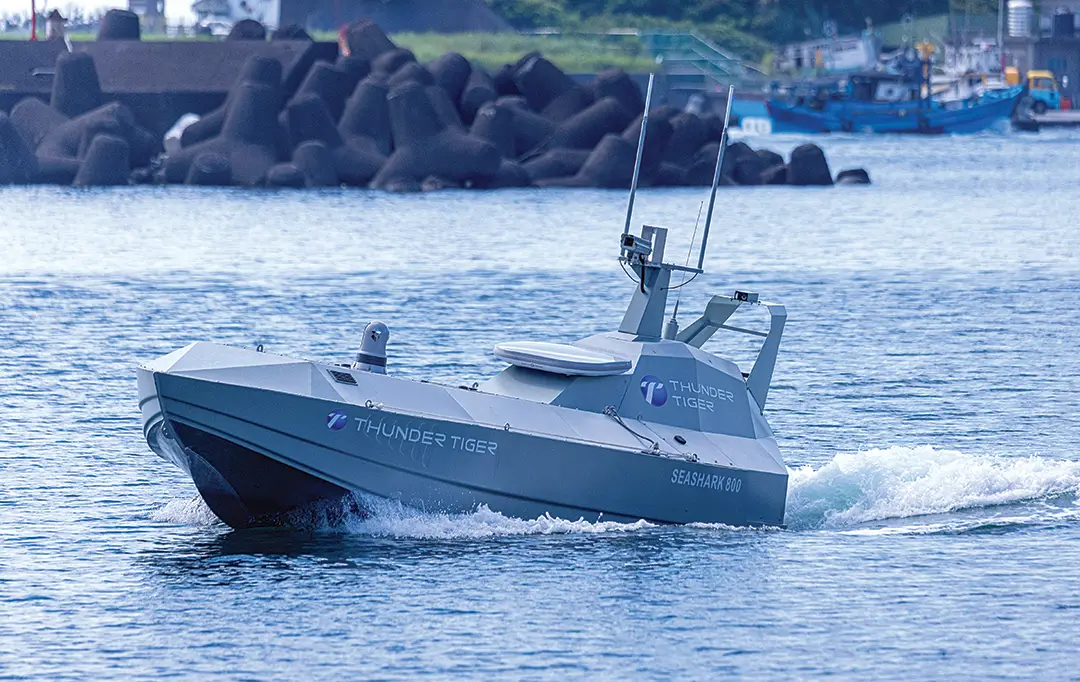
The twin-engine SeaShark 800 motorboat, for example, can carry 1,200 kilograms of explosives and has a range of 500 kilometers. “We can create uncertainty,” William Chen, chairman of the Taiwan-based drone manufacturer Thunder Tiger, told Reuters. “We can fill the Taiwan Strait with danger and risks. No one knows where these dangers could surface.”
In the Philippines, the U.S. Marine Corps temporarily deployed a unit of drones to support maritime security in the South China Sea, the U.S. Naval Institute News reported in November 2025.
Australia provided additional drone training to 30 Philippine Coast Guard officers in late 2025 to improve maritime security capabilities. The training followed delivery of $36 million worth of aerial drones and associated training to the Coast Guard, the Australian Embassy in Manila said.
Canberra announced Project Land Acquisition and Next-generation Development 156 in 2025 to rapidly deliver drone-defeating technologies to the Australian Defence Force, with initial contracts worth $16.9 million issued to 11 vendors.
U.S. defense firm Anduril Industries opened a manufacturing facility in Sydney, Australia, in October 2025 for its Ghost Shark undersea drone. The fleet is to be delivered to the Royal Australian Navy under a $1.1 billion five-year contract.
For Indo-Pacific countries, it is “important that these systems become affordable, scalable and increasingly autonomous, so that defending against drones doesn’t bankrupt the defender,” Molloy said.
In South Korea, the U.S. activated a squadron of MQ-9 drones at its air base in Gunsan in September 2025. The long-range drones can conduct surveillance and attack missions, and could be deployed to surveil North Korea and monitor activities in the Yellow Sea, analysts say. Seoul also is seeking to deploy advanced counter-drone systems that pair radar with jamming technology to neutralize small drones.
Small UAS are “the defining threat of our time,” U.S. Army Brig. Gen. Matt Ross, director of the JIATF 401, told reporters in December 2025. “Our formations must be able to detect, track, identify and defeat these systems anywhere on the planet,” Ross said. “This requires us to layer our defenses by integrating sensors with kinetic and nonkinetic efforts and battle management systems into a responsive, interoperable network.”