Responsible Partner
The Philippines’ former military chief reflects on challenges facing the nation and the power of partnership

FORUM Staff
In a time of rapidly evolving security challenges, the Armed Forces of the Philippines (AFP) is navigating complex traditional and nontraditional threats while expanding and reinforcing partnerships across the Indo-Pacific and beyond. After becoming AFP chief of staff in July 2023, Gen. Romeo Brawner Jr. led the multidomain transformation and overseen an expansive military modernization that has positioned Manila as a key strategic partner in upholding peace and stability in Southeast Asia and the wider region.
Gen. Brawner retired in July 2026 after a highly decorated military career spanning more than three decades. A native of Baguio, a city in the Philippines’ northern island of Luzon, he graduated from the Philippine Military Academy in 1989. Prior to leading the AFP, he was the Philippine Army’s 65th commanding general. He also served as chief of the 6th Special Forces Company and 2nd Special Forces Battalion, operations officer in the Special Forces Regiment, chief of the Army’s 6th Infantry Division, and commander of the Civil-Military Operations Regiment.
Gen. Brawner has master’s degrees in information management, business administration and strategic studies. He was inducted into the United States Army War College International Fellows Hall of Fame in 2023 and awarded the Legion of Merit, Degree of Commander, for exceptional service.

As he looks toward new opportunities to serve his country, Gen. Brawner spoke with FORUM about internal and external security threats facing the Philippines, including the flash point of the South China Sea; the nation’s growing role in multilateral engagements with Southeast Asian neighbors and partners including Australia, Japan and longtime ally the U.S.; emerging domains such as cyber and space; and the increasing importance of joint exercises, intelligence sharing and preparedness.
“We believe that no single country can defend itself [alone], especially against the threats that we are facing now,” he said.
FORUM: What are the Philippines’ primary security concerns?
Gen. Brawner: What concerns us the most is internal security operations. We are hoping that by the end of 2026 we will have eliminated all terrorist groups and there will be no resurgence. Externally, our main concern is to ensure we contain China’s expansionist objectives. Right now, we are focusing on Bajo de Masinloc [Scarborough Shoal] because that is their target. We have to prevent them from gaining full control or even establishing facilities there. Once they are able to establish a facility, that’s it, that’s the end. We will not be able to reclaim it … they will be able to control the whole South China Sea.
FORUM: What is the Philippines’ role in its trilateral partnership with Japan and the U.S., and the defense grouping known as the Squad, which also includes Australia, Japan and the U.S.? How have these partnerships enhanced security and what lies ahead?
Gen. Brawner: Our role is to be a responsible partner. The assumption is that once we enter into minilateral or multilateral arrangements with other countries, we are on equal footing. Despite the advancement in technology or the advancement in their respective armed forces, we all have an equal standing. Whatever it takes to be a responsible partner, we have to do that. For instance, during multilateral maritime cooperative activities, because we are all partners, we have to contribute our share.
The new nontraditional threats — for instance, cyber, information, cognitive, space — all of these target several countries at the same time. The solution to that is to collectively address these threats. The best way to do that is to form coalitions, which we are effectively doing. By forming coalitions, you become stronger as a collective group of countries. All contribute to each other’s defenses, to each other’s deterrence posture.
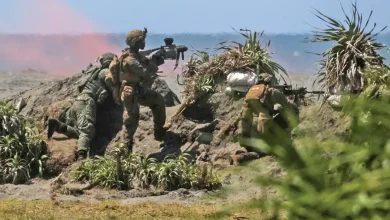
The way forward is to strengthen the relations by doing more collaborative activities together, by trusting each other more. For instance, by having more person-to-person exchanges, subject matter exchanges. Our objective is to have an officer embedded in the U.S. Pacific Command. We are just arranging the mechanics. They already have embedded officers from Japan, Australia and other allied nations like New Zealand. We plan also to embed an officer in Japan and Australia. In the same manner, we welcome these countries to be part of a command center, or control center, here in the Philippines. In the Balikatan 2026 exercise, we had not just the U.S. and the Philippines working together in a common command center, or Combined Coordinating Center, but we also had elements from Japan and Australia.

FORUM: What other security partnerships are important for the Philippines?
Gen. Brawner: We’ve long established Indomalphi [with Indonesia and Malaysia] and Philindo [with Indonesia] to address cross-border issues such as smuggling and human trafficking. Now, we’re strengthening ties with India and South Korea. With South Korea, we have already procured a lot of defense items from them — FA-50 [light combat aircraft], KM-450 and KM-250 vehicles, K-3 machine guns, and frigates, corvettes and offshore patrol vessels. Canada is also a key partner, especially since we signed a visiting forces agreement. They’re very serious about their Indo-Pacific strategy and are assigning a three-star general to be based in Manila. Their support includes cyber defense, maritime domain awareness and intelligence sharing.
FORUM: What are the AFP’s priorities for training and modernization?
Gen. Brawner: Priorities are newer technologies like cyber, artificial intelligence and space. Since we already conduct kinetic warfare training through exercises like Balikatan and Salaknib, we focus on high-technology training. We believe that with the state of the modernization that we have now, we can compete with other armed forces, even advanced armed forces when it comes to cyber. Looking at the wars in Ukraine and [the Middle East], we need to develop unmanned and autonomous systems — air, surface and subsurface drones — as well as missiles and missile defense.
FORUM: Can you tell us about the concept known as One Cooperative Effort Among Nations, or OCEAN, and how it’s being operationalized?
Gen. Brawner: We have to consider the first island chain [a string of archipelagoes stretching from Japan to Indonesia] as one theater. We now consider this whole area as one where we could cooperate in several aspects: economics, trade, defense, security, information and others. So, it’s not just military, but it’s a more expanded concept that would define cooperation. One very concrete effort is during disasters and calamities. Because of this concept, it’s now very easy for other countries, especially in the first island chain, to send assistance. This makes it easier for countries like Japan, the U.S. and Australia to provide humanitarian assistance and disaster response operations. If this is
put into action, it would be easier for armed forces to coordinate with each other.

FORUM: Tell us about the AFP’s plans to establish a space unit.
Gen. Brawner: We are already using space technology, but we don’t have our own satellites. We plan to create a space unit, or maybe a space group, that will cater to the AFP’s requirements for information coming from space: satellite images, imaging, and the linking of information and communications. Number one is the improvement of our communications through satellite links and satellite imaging, which are necessary for intelligence analysis and operational planning. Even if we don’t have our own yet, we already have satellites that we can tap for our needs. We need a dedicated unit that will harness this information and develop that capability so that we will have our own.
FORUM: How would you describe your tenure as AFP chief of staff?
Gen. Brawner: When I came in, we started reorganizing according to the threats that we are now facing. Aside from the traditional domains of warfare — air, land and sea — we now have information, cognitive, cyber and space. In my conversations with my counterparts, almost all armed forces around the world are reorganizing as well. The new technologies that are coming in will define the new character of warfare — drones, cyber, unmanned systems, autonomous systems. In my first year, we organized the Armed Forces Intelligence Command because we saw the need for the elevation of our intelligence to a strategic level. Initially, because we were facing internal security threats, our intelligence was focused on that — high-value targets from terrorist [groups]. Now we have to study other threat groups outside the country. We have to elevate our intelligence analysis. That’s why we have the Armed Forces Intelligence Command.
We also created the AFP Counterintelligence Group because, aside from the traditional threats, we are now facing destabilization efforts from within the country. We have to guard against that. And then the Cyber Command. From a cyber group, we made it into a command. We are really bent on developing our cyber capabilities so that we are not just able to defend, but we will be able to do offensive cyber operations.

We created the AFP Joint Logistics Command because we realized that in order to win a war, you have to sustain the war. Logistics has to be elevated. Next, we created the AFP Civil-Military Operations Command, which will deal with the information and cognitive domains. If you look at the environment now, there is lots of misinformation and disinformation, so we need a unit dedicated to dealing with this cognitive and information warfare. We also created the Strategic Command because we realized that we need a command that is ready to fight threats from outside. It’s the same with Japan. It created its Joint Operations Command recently because of that need.
That was what I was able to do — reorganize, establish more capabilities for the armed forces and, in another aspect, we were able to establish closer relations with partner countries. In 2026, as chair of the Association of Southeast Asian Nations (ASEAN), the Philippines also has taken over the leadership of the ASEAN Observer Team in maintaining the peace between Thailand and Cambodia. That is a very important role that we are playing because if we are successful in this aspect, this could set the future for conflict resolution among ASEAN nations. We believe we are writing history by doing that.
Correspondent Frances Mangosing contributed to this interview, which was edited to fit FORUM’s format.