Sustain Forward
Allies and Partners Champion Collaborative Ventures to Boost Defense Supply Chains
FORUM Staff
The United States and its Allies and Partners are enhancing the defense supply chain with the Partnership for Indo-Pacific Industrial Resilience (PIPIR). The 14-nation forum works with industry, capital providers and other stakeholders to strengthen military industrial resilience, expand capacity, and accelerate production and deliveries.
“It’s one thing for an adversary to see multinational forces operating together in exercises,” U.S. Secretary of War Pete Hegseth said in his 2025 address at the Shangri-La Dialogue. “It’s another thing entirely for that same country to see an integrated defense industrial base supporting those forces and standing ready to keep them in the fight.”
Hegseth unveiled PIPIR’s initial projects at the annual defense forum in Singapore in May. The first enables Australia to repair radar systems for U.S.-manufactured P-8 maritime patrol aircraft. That means Allies and Partners with the P-8 in their fleet, including Australia, India, New Zealand and the Republic of Korea (ROK), can get radar repairs closer in the region rather than relying on a maintenance destination in the U.S.
A second project calls for developing standards for uncrewed aerial systems, including identifying production sources for components to increase global supply chain resilience. Hegseth said the U.S. also would expand existing contracts to broaden Army watercraft repair capabilities across the Indo-Pacific.
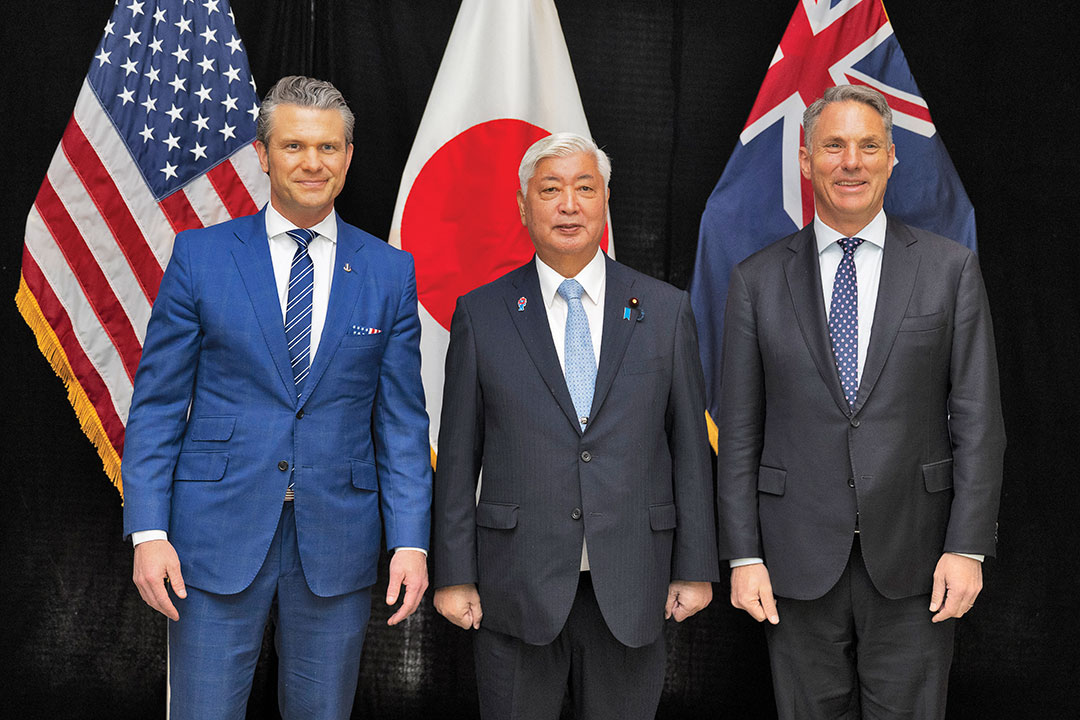
Australian Defence Minister Richard Marles and then-Japanese Defense Minister Gen Nakatani endorsed the efforts after meeting with Hegseth in Singapore.
“We confirm our intention to promote multilateral defence industry cooperation in the Indo-Pacific region, in terms of production, sustainment, and supply chain cooperation opportunities, including the … PIPIR work stream efforts, with the participation of our respective public and private sectors,” they said.
PIPIR essentially is a forum for armaments directors to resolve common acquisition and sustainment issues. It follows the European model for the Ukraine Defense Contact Group (UDCG), a collaboration of more than 40 countries to accelerate armament deliveries to Ukraine by synchronizing international procurement, production and sustainment.
A key difference: UDCG operates as a crisis response group. PIPIR is intended to be a more structured and sustainable defense industrial effort, wrote Connor Fiddler of the Foreign Policy Research Institute, a U.S.-based think tank.
“We don’t have the active conflict the way you do in Europe, so that’s going to be different. And then the other piece, of course, is that distances are different. Geography is different, so where you might want to do sustainment or production matters,” then-U.S. Undersecretary of Defense for Acquisition and Sustainment William A. LaPlante told Breaking Defense, a U.S.-based publication, in August 2024.
The U.S. already works with Allies and Partners to produce weaponry and repair assets to deter aggression. Australia, for instance, is scheduled to assemble Guided Multiple Launch Rocket Systems (GMLRS) under agreements with the U.S. Canberra and Lockheed Martin Australia also plan to mass-produce GMLRS rockets for global customers by 2029 at a new facility at the commonwealth-owned Benalla Munitions Factory. The components will include warheads and motors, according to Australian Defence Magazine.
PETTY OFFICER 1ST CLASS ALEXANDER KUBITZA/U.S. NAVY
ROK and U.S. defense officials set the stage to cooperate further on maintaining, repairing and overhauling (MRO) military equipment, including aircraft and tanks, Seoul’s Defense Acquisition Program Administration said in May 2025. U.S. military assets, such as F-16 fighter jets, have been maintained in South Korea. The proposed expansion would allow Seoul to provide MRO on U.S. equipment in more locations, the Yonhap news agency reported.
Taichung, Taiwan, is home to a U.S.-backed F-16 maintenance center completed in 2020 in collaboration with the self-governed island’s Aerospace Industrial Development Corp. and Lockheed Martin. The partnership provides MRO for Taiwan’s F-16 fleet.
Meanwhile, India and the U.S. held the inaugural industry-government experts exchange in April 2025 as part of their autonomous systems industry alliance.
“The rules have changed. It is no longer enough to announce alignment. Reestablishing deterrence … requires more than presence,” said Shyam Tekwani, a professor at the Daniel K. Inouye Asia-Pacific Center for Security Studies in Hawaii. Deterrence “requires persistence, prepositioned infrastructure, and partnerships that remain functional under pressure. The real contest is about delivery, who co-develops… who delivers when radars go dark and supply chains seize up,” Tekwani wrote in June 2025 in the center’s Security Nexus journal.
Enlisting Allies
In Singapore, Hegseth said the U.S. also will make greater use of “our Allies’ world-class ship repair capabilities to enhance the U.S. Navy’s operational effectiveness.”
U.S. law generally prohibits warships from undergoing major overhauls or repairs in foreign shipyards. Exemptions are allowed if the project takes less than six months and the vessel is not due stateside soon. Expanding capabilities has become a priority as the U.S. Navy seeks additional shipyards in the Indo-Pacific to maintain and repair forward-deployed assets.
Relocating MRO operations nearer active theaters reduces project timelines and enhances mission availability, analysts and military officials say.

The U.S. War Department’s 2024 Regional Sustainment Framework seeks to “better equip the warfighter with a network of globally dispersed capabilities that deliver MRO closer to the point of need [to] build a collective and resilient co-sustainment ecosystem by developing sustainment strategies that promote joint/allied regional MRO and foster collaborative relationships to expand repair network capacity across warfighting domains.”
Partnerships mitigate logistical challenges in the vast Indo-Pacific. In-theater MRO and capability production, for example, can more quickly deliver assets for deterrence within the first island chain, a line of major Pacific archipelagos off East Asia that includes Japan, the Kuril and Ryukyu islands, Indonesia, Malaysia, northern Philippines and Taiwan.
“The asymmetric advantage against our would-be adversaries is this friendship, this network of orientations and partners,” Adm. Samuel J. Paparo, Commander of U.S. Indo-Pacific Command, said at the Land Forces Pacific symposium in May 2025 in Hawaii. “We must have a constellation of like-minded nations and with the ability to cooperate and maintain resilient supply chains as well. From us to Japan, from the Republic of Korea and Australia to our ASEAN (Association of Southeast Asian Nations) partners to our partners in the Indian Ocean, our region and strength lies in our ability to interoperate.”
Among the examples of MRO cooperation:
India serves as a maintenance hub for U.S. Navy assets after the U.S. signed ship repair agreements with Mazagon Dock Shipbuilders and Larsen & Toubro in 2023. The yards build some of the Indian Navy’s largest and most advanced warships, the U.S. Naval Institute reported.
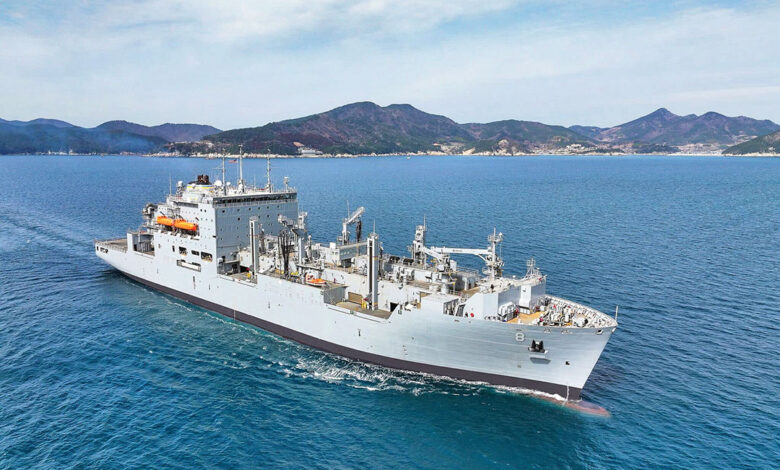
South Korean shipbuilder Hanwha Ocean secured a U.S. Navy contract in August 2024 to overhaul the USNS Wally Schirra, a 40,000-ton cargo and ammunition ship. The company completed the work in March 2025 and also won a contract to overhaul the USNS Yukon, a fueling ship. South Korea “has immense capacity and capability on its shores,” U.S. Army Gen. Xavier T. Brunson, commander of U.S. Forces Korea, said at the May 2025 Land Forces Pacific Symposium in Hawaii.
Rear Adm. Neil Koprowski, then commander of U.S. Naval Forces Korea, visited HJ Shipbuilding & Construction in South Korea in April 2025 in anticipation of the company joining the MRO effort with the U.S. “Cooperation with the world-class Korean shipbuilding industry is an important example symbolizing the steadfast commitment and enduring partnership of the Korea-U.S. alliance,” Koprowski said.
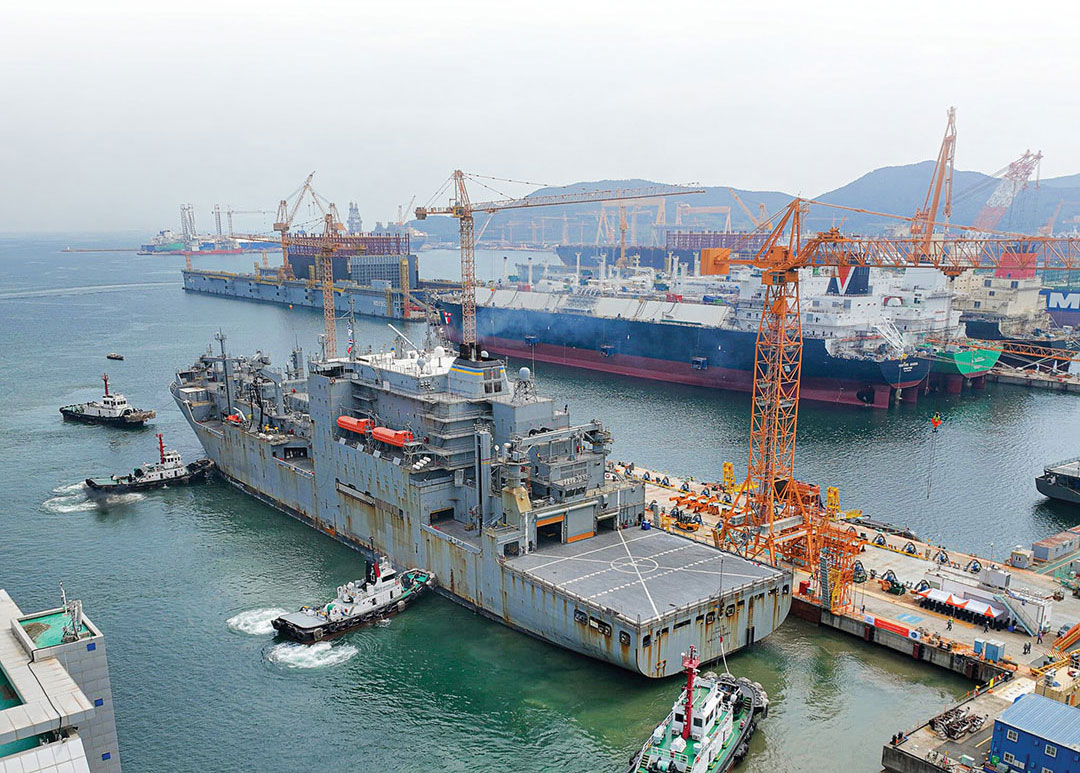
Japan’s Mitsubishi Heavy Industries in Yokohama completed a five-month overhaul of the USS Miguel Keith, an expeditionary mobile base, in April 2025. The work included replacing about 5,200 square meters of nonskid decking and more than 91 meters of flight deck catwalk handrails, as well as installing four galley ovens and repainting the hull. It was the first large-scale overhaul by a Japanese shipyard under a U.S. Navy MRO contract.
MRO can be an affordable alternative to asset replacement and allows fleets to be upgraded with cutting-edge technology to reinforce defense posture. The global naval MRO market is predicted to increase about 11% to nearly $66 billion in 2030. The U.S. also is expected to establish MRO hubs in Australia, the Philippines and Singapore, Nikkei Asia reported.

PHILLY SHIPYARD INC.
Shipbuilding Partnerships
Such MRO initiatives are part of a comprehensive push to transform the U.S. shipbuilding industry in concert with global Allies and Partners. China accounted for more than 53% of global commercial shipbuilding in 2024, according to the Center for Strategic and International Studies (CSIS), a U.S.-based think tank.
“Due to substantial industrial subsidies, China’s shipyards have gone from producing 5% of the world’s commercial ships in 1999 to over 50% and many of these shipyards embrace the Chinese Communist Party’s military-civil fusion strategy and produce warships for the Navy,” according to a May 2025 CSIS study.
U.S. lawmakers are seeking to boost the nation’s shipbuilding capacity with proposals to offer financial incentives and other strategies.
The Merchant Marine Act of 1920, commonly called the Jones Act, requires all goods transported by water between U.S. ports to be carried on a vessel that was built and registered in the U.S., and that is owned and primarily crewed by U.S. citizens.
“The main challenge is the established U.S. legal restrictions to protect the U.S. shipbuilding industry. The South Koreans have been consistent in delivering within time and within budget, but whether this will be possible for U.S. warships is another challenge because building a U.S. warship, with advanced technologies involved, might bring more restrictions,” In-Bum Chun, a retired ROK Army lieutenant general who is an outside director with HJ Shipbuilding & Construction, told FORUM.
The U.S. also is seeking to help rejuvenate domestic shipbuilding through a presidential executive order signed in April 2025 that calls for tax credits and other incentives to expand the U.S.-flagged international commercial fleet, while rebuilding the nation’s shipyard industrial base for military and commercial oceangoing vessels.
“Shipbuilding is a national security priority and a stopgap against foreign threats and coercion,” U.S. Sen. Todd Young said in April 2025. These proposals “will revitalize the U.S. maritime industry, grow our shipbuilding capacity, rebuild America’s shipyard industrial base, and support nationwide workforce development in this industry. This … is critical to our warfighting capabilities and keeping pace with China.”
At the same time, the U.S. is seeking to drive progress by transforming its defense relations with Allies and Partners to modernize the military industrial base.
For example, Japan and South Korea account for almost 44% of the global shipbuilding market, and commercial shipyards in those nations set milestones in 2025 by completing their initial MRO projects for the U.S. Navy. Additionally, Hanwha Ocean bought a leading U.S. shipbuilder, Philly Shipyard in Pennsylvania, for $100 million in June 2024. U.S. military officials hailed the acquisition as a “game-changing milestone for the new maritime statecraft” because it includes world-class leadership and innovation that will foster competition and energize the U.S. shipbuilding landscape.
By enhancing partnerships with Allies and Partners, PIPIR can fuel the success of new cooperative shipbuilding arrangements. “I am confident that this will happen. Industry wants to work and make money. Governments must help industry to reach their goals,” said Chun. “There are infinite possibilities, but it will take something like a PIPIR to be the glue.”