A New Era of Cooperation
Partnerships, Interoperability Create Asymmetric Space Advantage
FORUM Staff
In an increasingly contested orbital environment, the United States Space Force is augmenting its approach to space security and defense cooperation. With the release of its 2025 International Partnership Strategy, in support of U.S. Department of War (DOW) objectives, the Space Force has built a strategic vision on collaboration, interoperability and shared responsibility among the U.S. and its Allies and Partners. The approach aligns with the U.S. National Defense Strategy and the DOW International Space Cooperation Strategy.
“Space power is the ultimate team sport,” Gen. B. Chance Saltzman, then U.S. Space Force Chief of Space Operations stated in July 2025. “Space is simply too complex, too vast and too risky for any single power to control. Therefore, if the service is to achieve its mission to secure our nation’s interests in, from and to space, then it absolutely must cultivate partnerships with partners upon whom it can depend on to share its pursuit of a stable, secure and sustainable domain.”
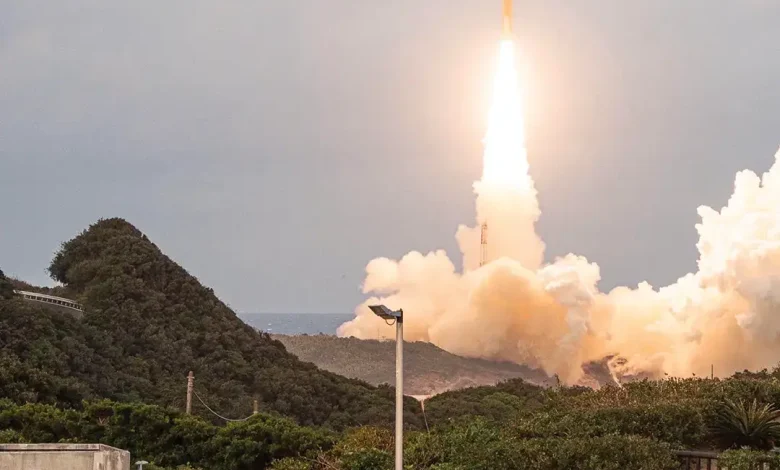
Space has evolved from a realm of scientific exploration to a strategic domain central to national security. It supports essential functions including global communications, navigation, missile defense systems, Earth observation and battlespace intelligence. Threats from anti-satellite weapons, maneuverable spacecraft and other capabilities are increasing, especially from authoritarian regimes, which pursue capabilities that could interfere with or damage vital satellites.
TECH. SGT. EMERSON NUÑEZ/U.S. SPACE FORCE
Military and civilian actors recognize the necessity of shared approaches to space security, specifically robust partnerships that enhance deterrence, resilience and responsible spacefaring behavior.
Strategic Imperative
The defining theme of the Space Force’s strategy is interoperability — with systems, data and personnel from different nations operating seamlessly. The International Partnership Strategy includes three goals to maintain space superiority and deter conflict:
Empowering Allies and Partners to be force multipliers to secure collective interests.
Enhancing communication by ensuring interoperable data, capabilities and activities while maximizing information sharing across classification levels.
Integrating partners across force design, development and employment.
The objectives require common standards for data, communication and operational concepts on a military and strategic level. The result will be allied and partner forces that can share information and respond jointly during crises.
Such interoperability is not a new concept. For decades, entities including NATO and the intelligence-sharing group among Australia, Canada, New Zealand, the United Kingdom and the U.S. have emphasized shared technical and procedural standards. Space, however, presents unique challenges. The speed of operations, lethality of threats and dual-use nature of many assets make real-time interoperability critical.
The Space Force’s holistic international strategy identifies lines of effort that span from the earliest stages of capability planning to joint operations, signaling the significance of partnership to space security objectives:
Creating conditions to integrate Allies and Partners’ military personnel into the Space Force.
Involving Allies and Partners in force development, which includes identifying and allocating resources.
Operating seamlessly as a coalition in exercises and real-world operations.
“So you can see that touches every single part of the Space Force,” U.K. Royal Air Force Air Marshal Paul Godfrey said at the 2025 Space Symposium in Colorado. Godfrey, in an exchange role with the U.S. Space Force, led the partnership strategy’s development and told Air & Space Magazine he is particularly interested in interoperability. He said different data links hampered cooperation when he was a fighter pilot in the 1990s.
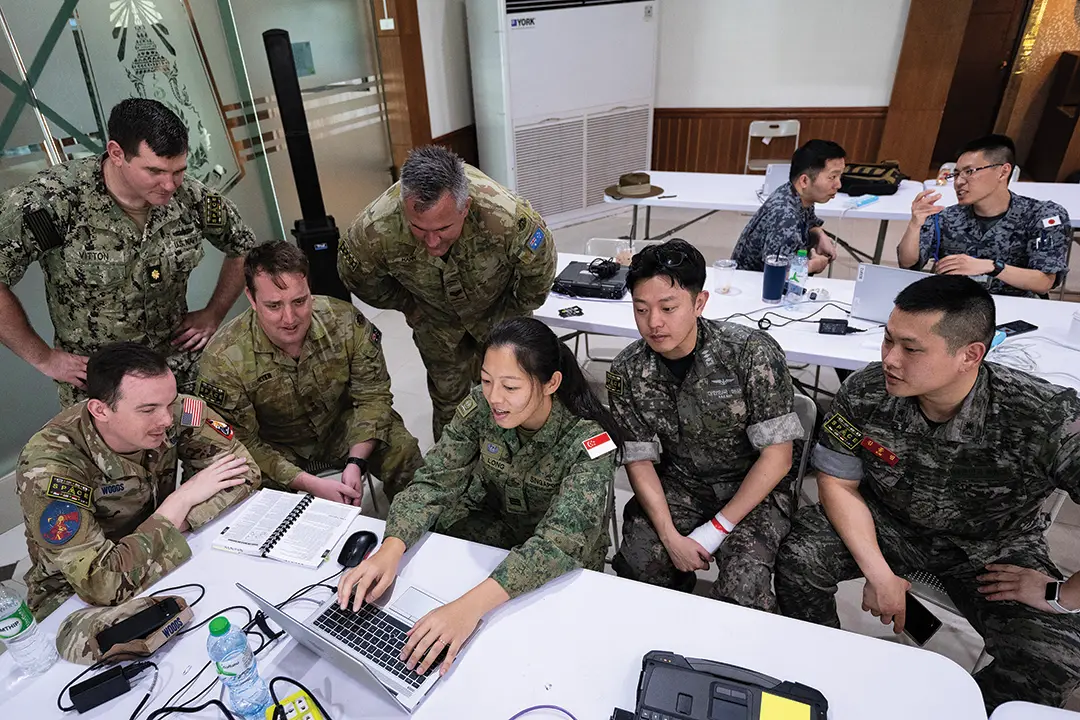
Saltzman and other senior leaders emphasize that interoperability is not only conceptual but also operational, with shared data standards and planning, integrated training, and joint exercises. Interoperability could mean Allies and Partners sharing real-time space domain awareness, participating in combined satellite maneuvers, operating under shared doctrines for crisis response and conducting combined missions under established procedures.
DAVID DOZORETZ/U.S. SPACE FORCE
Cornerstone of Cooperation
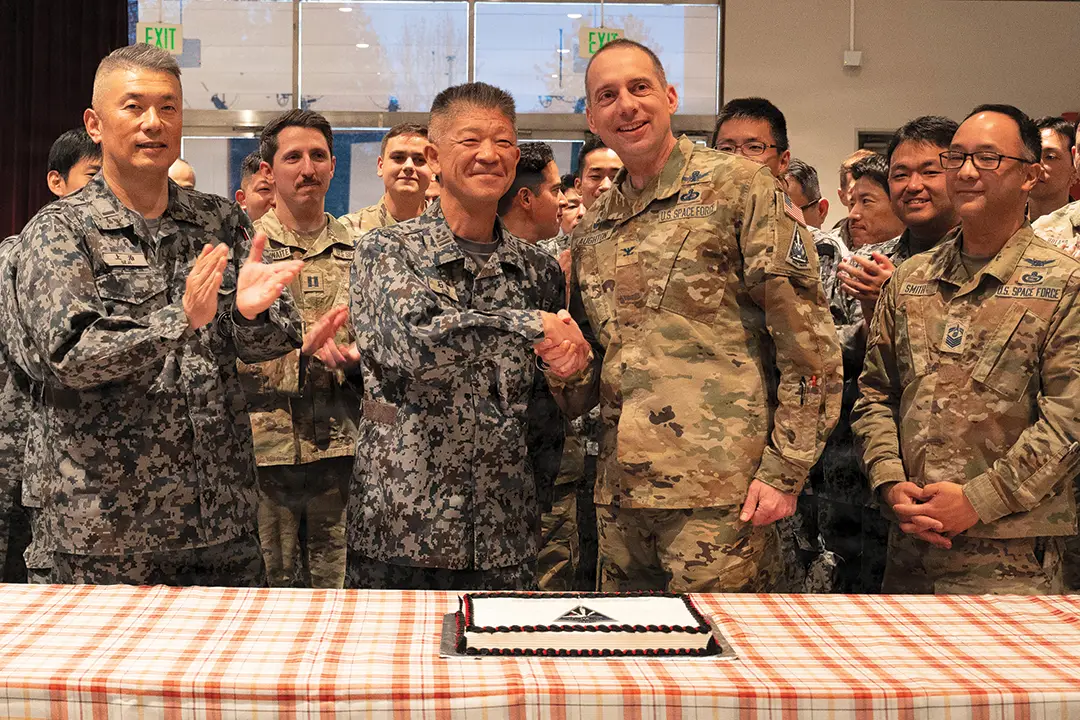
One example of multinational cooperation is the Combined Space Operations (CSpO) Initiative. Founded in 2014 with four nations, it now includes 10 spacefaring nations: Australia, Canada, France, Germany, Italy, Japan, New Zealand, Norway, the U.K. and the U.S. The program advances goals similar to the U.S. Space Force’s international strategy, promoting cooperation, interoperability and resilience, and intelligence sharing. Its vision underscores the shared commitment to collective security and sustainable use of space, guided by principles such as freedom of use and adherence to international law.
In late 2025, leaders from CSpO nations met in Toulouse, France, to reaffirm their commitment to interoperability and space security capabilities. U.S.
Space Force and U.S. Space Command (USSPACECOM) officials stressed that integrated coalition capabilities are essential to counter rapidly advancing threats. Gen. Stephen N. Whiting, commander of USSPACECOM, emphasized the “jaw-dropping speed” at which competitors are advancing in space, requiring “integrated coalition capabilities that deter aggression” and defend Allies and Partners’ interests.
“We are building a coalition capable of addressing the challenges of a contested space environment,” Saltzman said at the gathering. “To be effective, we must collaborate on our architectures, integrate our training, exercises and operations, and build a common understanding of the threats we face.”
Such CSpO cooperation dovetails with the Space Force’s interoperability goals, broadening the coalition of nations that train, plan and operate together in a crowded domain.

CHRIS DEWITT/U.S. Space FORCE
Regional Alignment
Broad defense partnerships across the Indo-Pacific and European-Atlantic regions reinforce interoperability and security cooperation in space.
Australia has long been a key U.S. ally. The AUKUS pact among Canberra, London and Washington originally focused on delivering advanced technology and nuclear-powered, conventionally armed submarines. Australian proposals to expand AUKUS into space cooperation reflect the nation’s interest in deeper integration with U.S. space security efforts.
Beyond AUKUS, Australia participates in multinational space operations and contributes geographic advantages, such as sensor locations in the Southern Hemisphere that enhance global tracking and space domain awareness.
Canada’s space collaboration with Allies and Partners has endured for decades, supported by defense and intelligence ties. A founding member of the CSpO, Canada is intensifying defensive and offensive space capabilities, Brig. Gen. Christopher Horner, commander of the Canadian Armed Forces Joint Force Space Component, told The Japan Times newspaper.
Like Australia, Canada is a member of Operation Olympic Defender, a multinational force to integrate military space power, enable combined forces, deter aggression and, if necessary, defeat adversaries. With members also including France, Germany, New Zealand, the U.K. and the U.S., the force declared initial operating capability in 2025.
“A year ago, we didn’t say the words ‘space control’ out loud because that was a classified thing. … But today I can say that those seven nations are certainly all moving towards expanding their capabilities in the space control realm,” Horner said in November 2025.
Japan and South Korea are vital U.S. allies in the Indo-Pacific with defense ties that increasingly emphasize space cooperation. Japan is a founding partner in the Artemis program, which will send astronauts to the moon for the first time since 1972 and build a foundation for human exploration to Mars. U.S. Space Forces-Japan activated in 2024 to support partnership agreements with Tokyo, deepen integration with Japanese space counterparts and meet dynamic regional challenges for a free, open and prosperous region.
South Korea’s expanding space capabilities — including planned satellite constellations compatible with the U.S. Global Positioning System and Artemis Accords commitments — further illustrate how interoperability extends to Indo-Pacific partners.
While Taiwan does not have a formal space defense alliance, recent U.S. moves to deepen technology cooperation suggest expanding collaboration in space-related areas. Taipei’s capabilities in semiconductor technology, electronics manufacturing and satellite development complement U.S. efforts to build interoperability and resilience across a wider constellation of partners.

European partners are integral to multinational space security initiatives. The U.K. and the U.S. routinely conduct combined space missions, such as the 2025 coordinated satellite maneuver during Operation Olympic Defender. “We are now, with our allies, conducting advanced orbital operations to protect and defend our shared national and military interests in space,” Maj. Gen. Paul Tedman, commander of the U.K. Space Command, said after the exercise.
Meanwhile, the European Union is exploring cooperative satellite networks with Japan, leveraging shared standards and joint ventures that could further enhance interoperability across regions.
The U.S. continues to engage with nations on space security issues, even as geopolitical competition grows. Through international treaties and diplomacy, Washington seeks to maintain dialogue aimed at preventing conflict in orbit. China, Russia and the U.S. all signed the United Nations-backed Outer Space Treaty, which in 1967 formed the basis of international space law. It establishes that outer space should be used for peaceful purposes and prohibits placing nuclear weapons in orbit. U.S. officials frequently point to the treaty as a cornerstone of global efforts to keep space secure and stable.
Engagement with China has included a bilateral dialogue on space security. Civil space cooperation between Russia and the U.S. has continued for decades, as exemplified by the International Space Station (ISS). Even amid tensions, the nations rely on each other to operate the orbiting laboratory. Both countries’ spacecraft transport crew members to the ISS while U.S. systems power the station and Russian thrusters maintain its altitude.
Interoperability in Action
Space defenders from NATO members and 29 partner nations — including Australia, Canada, Japan, New Zealand, South Korea, Thailand, the U.K. and the U.S. — embedded in regional space operations centers in April and May 2025 to rehearse maintaining national command and control of their sensors for planning, tasking and analysis. Exercise Global Sentinel simulations mirrored the platforms used for real-world space defense.
Three months later, nine partner nations tested strategies, evaluated technology and strengthened space cooperation with the Schriever Wargame at the U.S.’s Maxwell Air Force Base in Alabama. “Every time we come together, the domain looks different — new technologies, new commercial players, new dynamics,” said Justin Boileau, the 3 Canadian Space Division chief of advanced effects. “That makes it even more important to work together toward a common understanding so that everyone can benefit from space.” The wargame’s 2025 iteration also included Australia, France, Germany, Italy, Japan, New Zealand, Norway, the U.K. and the U.S. Planning is underway for Schriever Wargame 2027, where partner nations are expected to jointly set objectives for the first time.
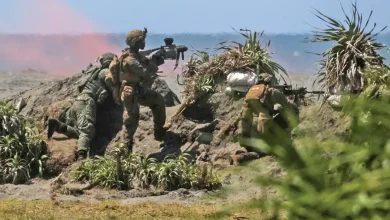
Meanwhile, planners routinely incorporate the space domain in multilateral exercises including Cobra Gold in Thailand, Balikatan in the Philippines and Talisman Sabre in Australia. Such training unites partner militaries to address space security issues, share tactics and procedures, and enhance mutual understanding of complex threats, broadening interoperability and strengthening collaboration.

Partner-Driven Future
Through CSpO, exercises such as Global Sentinel and the Schriever Wargame, and the International Partnership Strategy, the U.S. avoids imposing a unilateral framework for space. Instead, Washington seeks to co-construct a coalition of nations with shared values for mutual benefit. Allies and Partners bring unique strengths — from Australia’s geographic advantages to Pacific partners’ forward presence — that collectively enhance space security more than any single nation could provide.
Challenges include disparities in technology, doctrine and funding. Balancing defense imperatives with civil space goals, such as scientific exploration and economic expansion, will require diplomacy. Strategic competition also affects coalition-building in the space domain.
The U.S. Space Force’s International Partnership Strategy reflects a shift in how space security is conceptualized and operationalized. Allies and Partners reject unilateral control of the vital domain in favor of building a resilient, interoperable coalition that can deter conflict, share information and respond collectively to threats.
Interoperability — in data, operations and strategic planning — lies at the heart of this approach. By weaving together global capabilities, the U.S. and its Allies and Partners are shaping a collective security architecture in space that supports freedom of access and responsible conduct.