Beyond the Front Line
Strong Support Systems Enhance Global Defense Posture

Sentry
Defense leaders don’t just consider the front lines when planning for battle. Support systems that ensure combat readiness and endurance remain crucial. Shifts in geopolitical dynamics, combined with emerging technologies, make attention to those support systems — sometimes called the “strategic rear” — critical. In addition, today’s multidomain operations require systems that enable the ability to communicate across the joint force and with Allies and Partners.
The strategic rear has historically included command and control (C2), logistics and sustainment infrastructure, personnel and reserves, and security measures to protect high-value assets. Those principles remain regardless of technological advances in warfare, but today’s complex global environment also demands attention to data sharing and interoperability, which play a vital role in strategic posture.
“Modern warfare is undergoing a transformation in which information is no longer just a combat multiplier — it is the battle space,” Benjamin Jensen, director of the Futures Lab at the Center for Strategic and International Studies (CSIS), wrote in “War and the Modern Battlefield,” a September 2025 report by the United States-based think tank. “The ability to collect, fuse, and disseminate information is a defining feature of military power and calls for new ways of thinking about the correlation of forces and means in modern war.”
The U.S. and its Allies and Partners are strengthening data sharing and interoperability in key areas that build the strategic rear to counter threats as competitors develop their own capabilities.
Next-Generation C2
Joint All-Domain Command and Control (JADC2) is the U.S. military’s push to upgrade systems that will protect the joint force’s C2 capabilities. The goal is “to empower our joint force commanders with the capabilities needed to command the joint force across all warfighting domains and throughout the electromagnetic spectrum to deter, and, if necessary, defeat any adversary at any time and in any place around the globe,” the U.S. Department of War reported in 2022.
“JADC2 provides a coherent approach for shaping future Joint Force C2 capabilities and is intended to produce the warfighting capability to sense, make sense, and act at all levels and phases of war, across all domains, and with partners, to deliver information advantage at the speed of relevance.”

The report identified five areas to achieve capability goals:
- The data enterprise: Data is a strategic asset to be managed, maintained and protected. “To accelerate decision-making, the joint force and our mission partners must be able to discover and access any data and information from all warfighting domains and at all levels of warfare.” Standardization objectives include metadata tagging, access practices and security best practices.
- The human enterprise: The use of artificial intelligence and machine learning tools to collect and aggregate data while establishing authority chains for rapid decision-making. Professional development programs would prepare leaders across all warfighting domains.
- The technical enterprise: Operations including enhanced shared situational awareness, collaboration, planning, real-time force visualization and management, and improved abilities to assess joint force and mission partner performance. “Joint force commanders require secure, worldwide communications networks with sufficient speed and bandwidth” for decision-making.
- Integration of nuclear C2 and communications (NC3) with JADC2: The U.S. Strategic Command has identified modernization of NC3 systems as a vital part of upgrading the nation’s nuclear triad and enhancing deterrence. Combined JADC2 will provide the framework and methodology to allow interoperability between conventional C2 capabilities and NC3, ensuring commanders’ intent by providing automation for accelerated decision-making. The new capabilities will also provide resilience and redundancy, bolstering strategic deterrence.
- Modernize mission partner information sharing: This priority seeks a common understanding of the operational environment among the U.S. and its Allies and Partners. In addition to the U.S.’s JADC2 initiative, Allies and Partners including NATO and the United Kingdom are developing enhanced data sharing and C2 capabilities. “Ideal mission partner system integration is realized when data from each partner’s C2 systems can be accessed, viewed, and acted upon by every other approved partner,” the report stated. “Ultimately, JADC2 system interoperability is foundational for conducting combined and partnered operations with speed, precision, relevance and security.”
Sustaining Operations from the Rear
Having the right equipment and supplies at the right place at the right time is vital not only for readiness but also for maintaining a strategic posture that can enhance deterrence. “Even as warfare evolves and the concepts, equipment and supplies develop and change, there can be no success in warfare without the logistics enterprise,” Cynthia Cook, a senior fellow with CSIS’s Defense and Security Department, wrote in the center’s 2025 report. “There is a persistent cliché that amateurs study strategy and experts talk logistics. A more exact formulation would be that experts understand the importance of logistics and readiness to their strategy, and plan and resource accordingly.”
As the risk of protracted wars such as the Russia-Ukraine conflict increases, the need for large stockpiles to be ready — or rapidly surged — also grows, Cook wrote. With the development of hypersonic weapons, advanced cruise missiles and uncrewed aerial systems, areas previously considered safe are at risk. Geographic distance no longer guarantees security, requiring weapons systems, infrastructure and networks to be hardened or designed for redundancy to ensure continued operations.

STAFF SGT. CEDRIQUE OLDAKER/U.S. AIR FORCE
Sustainment is an increasingly vital element of integrated deterrence, Christopher Lowman, then U.S. assistant secretary of defense for sustainment, wrote in a January 2024 article for National Defense magazine. “Today, the strategic environment is defined by challenges to logistics agility, flexibility and survivability through kinetic and non-kinetic disruptions,” he wrote. “To navigate and prevail through a contested logistics environment means ensuring that logistics, supply chain operations and transportation capabilities are resilient and can operate effectively in hostile environments.”
Defense leaders “must ensure that the combatant commands are postured with sufficient resources such as munitions, fuel and spare parts. They must also have the capabilities to perform maintenance, manufacturing at echelon, storage and transportation, and withstand and recover quickly from disruptions,” Lowman wrote.
He noted that advanced manufacturing techniques, including 3D printing, could mitigate the risks of disrupted or contested supply chains, allowing the joint force to “produce crucial parts in contested environments in a distributed manner, increasing an adversary’s dilemma and ultimately U.S. integrated deterrence posture.”
Defense leaders also must consider the unique nature of the Indo-Pacific, where vast scale, complex topography and susceptibility to natural disasters present complex challenges.
Any Indo-Pacific conflict or war over self-governed Taiwan, which China claims as its territory and threatens to annex by force, “would be fought at sea and in the air, across thousands of nautical miles, and against a peer adversary with robust [intelligence, surveillance and reconnaissance] and precision strike capabilities,” Cook wrote in the CSIS report. “Nations participating in that or any other conflict could not assume secure overflight rights, permissive air bases, or nearby overland supply routes. Logistics would be contested, and the persistence of satellite surveillance means that operating in secrecy is increasingly impossible.
“Along with the warfighting capabilities of potential adversaries, nations should look to understand an enemy’s logistics capabilities and investments as an indicator of how challenging any engagement might be.”

Sustaining the force
In a military conflict, necessary personnel aren’t limited to front-line troops. Forces also need staff to maintain the strategic rear — ensuring that essential logistical, administrative and command functions continue uninterrupted. In 2022, the U.S. Army updated its operational concept from unified land operations to multidomain operations, acknowledging the increasingly complex battle landscape. “Multidomain operations require integration of Army and joint capabilities from all domains to defeat the enemy’s integrated fires, electronic warfare, cyber, and air defense systems, and to allow maneuver forces to exploit the resulting freedom of action,” the U.S. Army reported in January 2025. In addition, combatant commands tailor rotational forces based on the type of operation, geographic location, operational environment and potential threat.
Defense forces also must train together. Increased demand for interoperable systems requires military and support personnel to integrate as well. Large-scale, combined exercises bring Allies and Partners together to rehearse not just military maneuvers but also the logistical and support activities required for mission success.
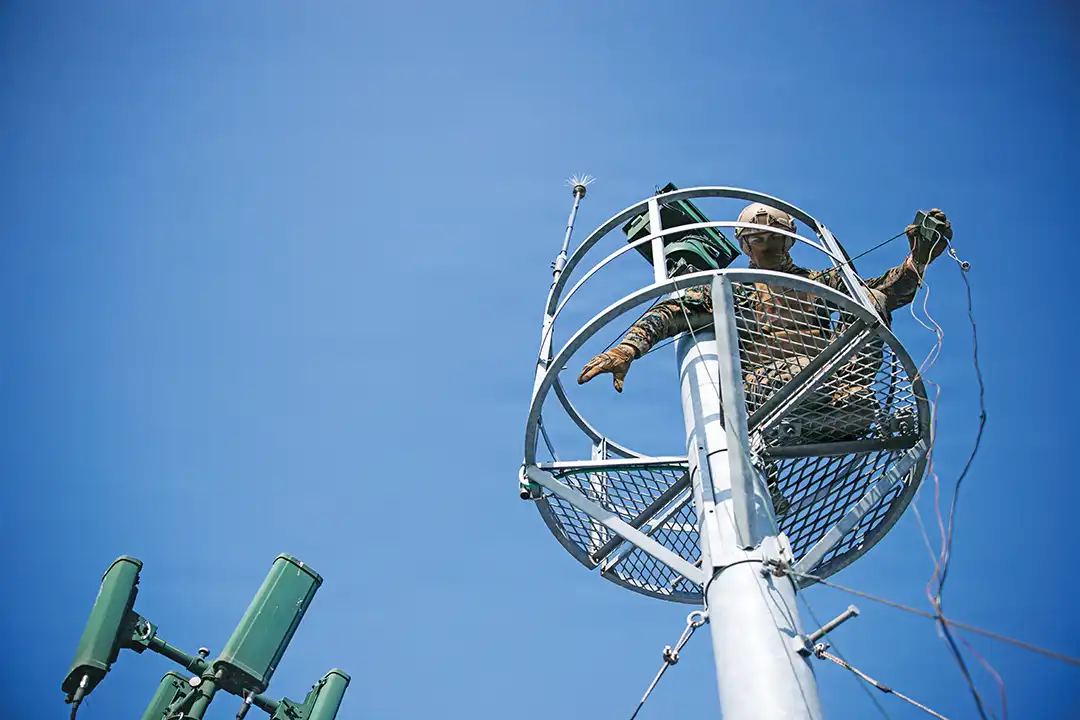
To enhance regional defense, the Quadrilateral partnership of Australia, India, Japan and the U.S. established the Indo-Pacific Logistics Network in September 2024 to leverage shared capabilities. The project reflects a long-term strategic goal to integrate logistics, basing and sustainment infrastructure across the Indo-Pacific.
Such exercises and initiatives remain crucial to sustaining a strong deterrence posture, Patrick Kelleher, U.S. deputy assistant secretary of war for materiel readiness, said during a July 2025 discussion hosted by CSIS. “When we look at the conflicts that are ongoing, [the focus] is our ability to endure,” he said. “Our ability to endure through logistics by generating and maintaining readiness is as much a deterrent effect, or should have as much a deterrent effect, on an adversary as anything else.”
Sentry is a professional military magazine published by U.S. Strategic Command to provide a forum for national security personnel.