Beijing drives maritime militia aggression in South China Sea
Sarah Chan
The strategic contest in the South China Sea increasingly is waged not by warships but by dual-purpose fishing trawlers. State-directed maritime militias, operating in the murky space between civilian seafaring and military operations, have become Beijing’s vessels of choice for pushing its arbitrary territorial claims. In response, Allies and Partners are adapting, blending law enforcement, diplomacy and naval presence.
China’s maritime forces have grown more aggressive in 2026, including firing water cannons at Philippine vessels operating lawfully near Scarborough Reef, as well as instigating armed clashes. Some skirmishes involved vessels from China’s People’s Armed Forces Maritime Militia.
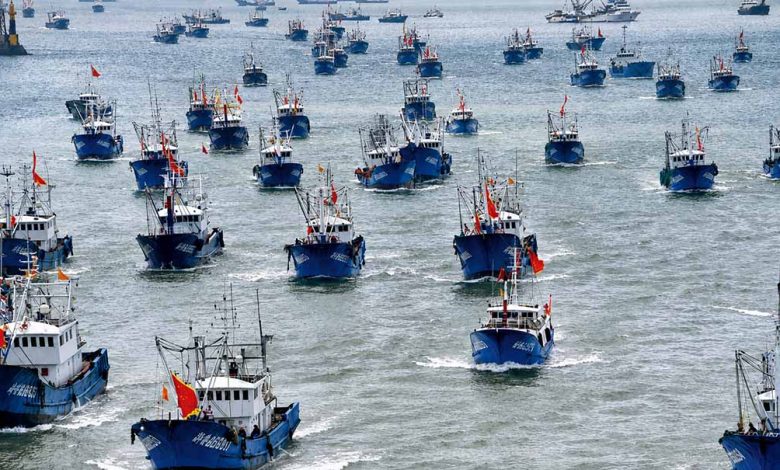
The militia maintained a record daily average of 241 vessels in the South China Sea in 2025, according to the United States-based Center for Strategic and International Studies’ Asia Maritime Transparency Initiative (AMTI). Steel-hulled trawlers anchored in dense formations at Whitsun and Mischief reefs have formed blockades, and Beijing has assembled militia vessels into formations stretching up to 470 kilometers, moves that analysts view as rehearsals for confrontations.
“You can put a lot more so-called fishing ships out there than a Southeast Asian government can put coast guard or navy ships,” AMTI Director Gregory Poling told FORUM.
The tactic also shifts the burden of escalation onto nations that counter China’s aggression. For example, if the Philippine Coast Guard uses force against these purportedly civilian vessels, Poling said, “it plays into China’s hands, where Beijing can claim that the Philippines was the aggressor.”
Plausible deniability is part of China’s strategy, Thomas Lim, an associate research fellow at Singapore’s S. Rajaratnam School of International Studies, told FORUM. He noted that deploying such vessels enables Beijing to maintain a facade while performing military functions.
With other maritime nations refusing to surrender their claims, however, China is moving “dangerously close to crossing the line from gray zone coercion into the outright use of force,” Poling said.
Nations including Brunei, Malaysia, the Philippines and Vietnam assert rights to maritime areas that overlap China’s sweeping claim to most of the South China Sea, a vital trade route and source of fossil fuels, minerals and fish. An international tribunal in 2016 rejected China’s claim in a case brought by the Philippines. Beijing has ignored the ruling.
— STORY CONTINUES BELOW —
Join the discussion
How does your nation respond to maritime incursions disguised as benign activity?
Rather than trying to match China ship for ship, Manila and Hanoi have refined their maritime domain awareness through radar, satellites and ship-tracking transponders, allowing them to concentrate assets at contested locations such as Second Thomas Shoal and Scarborough Reef.
Lim cited modernization initiatives, including Malaysia acquiring more vessels and the Philippines boosting its military capacity, as well as regional information sharing. He and Poling emphasized the value of like-minded partners such as Japan, South Korea and the U.S.
Poling framed the broader strategy as sustained presence paired with credible backup. “The primary focus of Philippine, Vietnamese and even Malaysian activity tends to be simply showing the flag, denying the Chinese militia and coast guard the ability to argue that they effectively administer these waters,” and ensuring that if confrontation occurs, the international community sees who escalated first.
Sarah Chan is a FORUM contributor reporting from Singapore.