Taiwan’s annual Han Kuang exercise focuses on real-world contingencies
FORUM Staff
Taiwan’s military and civic preparations for a potential crisis such as an invasion by China reflect a whole of society approach. The self-governed island’s Han Kuang exercise in mid-August 2026 embraced that dual strategy as never before.
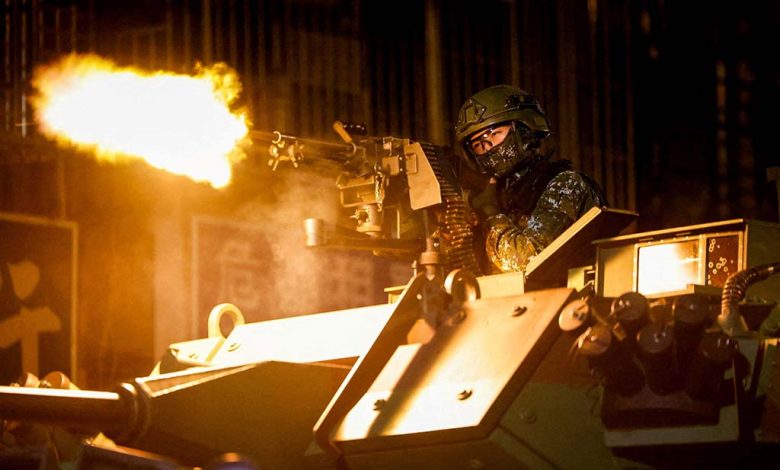
Han Kuang’s 42nd annual iteration tested evacuation and sheltering, traffic control, emergency response and civil-military coordination, The Diplomat magazine reported. The drills, designed to infuse civilian support into the operational defense environment, complemented military-oriented preparations that included assessing a command structure influenced by the United States. Known as “backbriefing,” it entails subordinates explaining to commanders how they will perform an assigned mission. The drills encourage fighters to be more self-reliant and effective.
Until 2025, Han Kuang focused primarily on military hardware and personnel movements. The 2026 exercise raised the mission to a new level.
Civilian resilience is seen as vital to Taiwan’s capacity to project deterrence. Military aid, resupply and crisis coordination are less effective if hospitals, power grids, logistics networks, communications and local authorities are incapacitated. The 2026 exercise tested those civic functions, with mobile internet speeds reduced for about 30 minutes, limiting communication to text in 14 jurisdictions to simulate interference during an attack.
The exercise also gauged how Taiwan’s residents could withstand information manipulation campaigns, economic pressure, service disruptions and other nonlethal, or gray zone, tactics.

China claims Taiwan as its territory and threatens to annex the island by force if necessary. Beijing routinely deploys air and maritime forces near Taiwan and increasingly stages large-scale military exercises off its coast, which analysts consider rehearsals for a blockade or invasion.
Military readiness rehearsed during Han Kuang included maintaining command and acting independently during a disruption, controlling key access routes to urban centers such as Taipei, and reassessing the strategic value of the Green and Orchid islands southeast of Taiwan’s main island.
The exercise incorporated 20,000 reservists and an infusion of U.S.-inspired protocols. “The most important new development in this year’s Han Kuang is the incorporation of American-style military training methods, which are aimed at enhancing the coordination and combat readiness of [Taiwan’s] military,” William Yang, a senior Northeast Asia analyst for the International Crisis Group, told The Associated Press (AP).
— STORY CONTINUES BELOW —
Join the discussion
How can partnering with the U.S. help your nation prepare civilian and military personnel for a potential attack?
Under the Taiwan Relations Act, the U.S. is committed to providing Taiwan with the means to defend itself.
During Han Kuang, government agencies and essential services tested their ability to continue operating during an invasion. Drills included an evacuation of Taiwan President Lai Ching-te amid a mock strike.
Taiwan’s defense budget rose about 7.5% from 2024 to 2025, and in May 2026 lawmakers passed a $24.8 billion, eight-year special budget to acquire U.S. arms. Lai said he intends to increase defense spending to about 3.3% of gross domestic product.
Han Kuang’s transition into a realistic test of society-wide wartime readiness and resilience reflects Taiwan’s increased emphasis on defense.
Allen Hsieh, a tourist from Hong Kong, was among metro train passengers delayed by a simulated air raid during Han Kuang. “I know that Taiwan needs to conduct exercises given the current situation,” Hsieh told the AP. “I did not expect it to be so real.”