Arctic Vigilance
Polar region nations are uniting and boosting countermeasures
FORUM Staff
Deepening cooperation in law, scientific research and marine technology in the Arctic were highlights of a 2019 pact between China and Finland. The relationship, as it pertains to the polar region, has since cooled. The nations’ 2025-2029 Joint Action Plan does not mention the Arctic.
When Finnish President Alexander Stubb visited Beijing in October 2024, mutual praise flowed at formal gatherings. But down-to-business meetings centered on Russia’s war with Ukraine and Beijing’s thinly veiled support of Moscow, a scenario that concerns Helsinki. Leaders ultimately approved measures on relatively benign issues such as trade, the environment and education.
The 2025-2029 strategy is just five pages, compared with the 30-page 2019 Sino-Finnish agreement that detailed joint initiatives in the region. “Overall, the focal points of the [Joint Action Plan] give an impression of shrinking cooperation,” the Norway-based High North News newspaper reported in November 2024.
What happened? Most prominently, the Russia-Ukraine war began in February 2022, transforming the region’s geopolitical and security environment. Amid concerns about its security, Finland, which has Europe’s longest border with Russia (1,340 kilometers), joined NATO in April 2023, followed by neighboring Sweden in March 2024. Baltic Sea data cables, a gas pipeline and a power cable were severed, under suspicious circumstances, in 2023 and 2024 by commercial ships linked to China and Russia. The sea borders Denmark, Finland, Sweden and other European nations.

Other Arctic nations also became wary of China, which has served as Russia’s High North proxy while the Kremlin wages its war with Ukraine. “The more China supports Russia, the more difficult the relationship with Europe, and especially the European Union, becomes,” Stubb said.
In some respects, China still feels the fallout from its 2018 self-depiction as a “near-Arctic” state, a portrayal that rankled countries with territory inside the Arctic Circle. China’s northern border is almost 1,500 kilometers outside the Arctic Circle.
All eight members of the multinational Arctic Council, a forum that promotes cooperation, coordination and interaction, initially were enthused about China’s interest in the region. The forum includes Russia and seven NATO states: Canada, Denmark, Finland, Iceland, Norway, Sweden and the United States. China is among the Arctic Circle’s 13 nonvoting observer nations, along with the Indo-Pacific countries of India, Japan, Singapore and South Korea.
Opinions about China among government officials and the public in the forum’s NATO countries have spiraled downward in recent years, influenced by Beijing’s increased links to Moscow, the nation with the most Arctic exposure, Trym Eiterjord, a Vancouver, Canada, researcher with The Arctic Institute, a Washington, D.C.-based think tank, told FORUM. “A lot of stuff has happened in the past year,” Eiterjord said in December 2025. “A lot of it, at least when it comes to China, has been reactions from Arctic countries, from NATO countries.”
Many of China’s forays into the Arctic — proposals to build power plants, airports and seaports in the extreme environment — have failed or remain on hold due to market factors, environmental hurdles, geopolitical challenges and security concerns. Its naval exercises with Russia trouble regional nations, as do Beijing’s human rights abuses in places such as Tibet and Xinjiang, and its aggressive maritime actions in the Indo-Pacific.
 The Sino-Russian naval exercises in the Arctic, and especially in international waters off Alaska’s coast, might partly be swipes at the U.S., which has condemned China’s hostile actions in the East China and South China seas, Eiterjord said. The U.S. and its Allies and Partners routinely transit the two seas to demonstrate freedom of navigation. Beijing illegally claims most of the South China Sea, where its Coast Guard ships have rammed, blocked and directed water cannons and lasers at other nations’ fishing boats and government vessels, particularly those of the Philippines. China also claims Japanese territory in the East China Sea.
China’s Arctic explorations echo research missions and academic assessments that preceded Beijing’s military expansion in the South China Sea, The Wall Street Journal newspaper reported in December 2025. China has built artificial features in the South China Sea that support military air bases.
Beijing has become less concerned about appearances in the Arctic. It no longer prioritizes impressing multilateral groups such as the Arctic Council. It now favors bilateral relations with Arctic nations and remains a key trade partner. Despite its remoteness, China has established a presence in the Arctic, using land-based research outposts and a fleet of oceanographic survey ships to explore sea topography, circumpolar features and space. It also participates in a regional group that opposes unregulated fishing, even though China’s distant-water fishing fleet has been linked to such illicit activity globally.
Still, there’s increasing skepticism about Beijing’s intentions. “China’s overtures have been met with suspicion in the Arctic states, where some analysts and commentators read nefarious intent into Chinese actions and statements,” the U.S.-based Harvard Kennedy School’s Belfer Center reported in June 2025. “China’s construction of critical infrastructure and investments in the strategically located and resource-rich Arctic have raised concerns about national security. … What is more, questions abound about the dual-use applicability of Chinese research activities in the region.”

Countermeasures
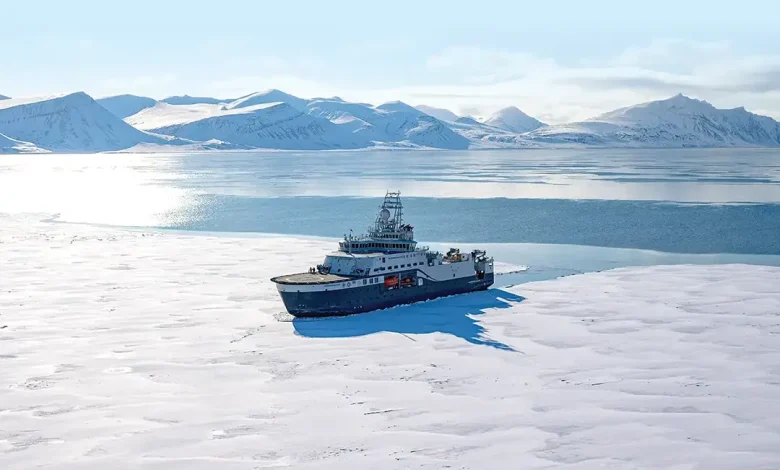
Finland is among the states enhancing asymmetrical defense capabilities in response to increased tensions. Expanding icebreaker fleets is part of that buildup. Canada, Finland and the U.S. in November 2025 celebrated advancement of their Icebreaker Collaboration Effort Pact. The endeavor aims to design, produce and maintain Arctic and polar icebreakers, as well as other capabilities — maritime operations for advanced navigation, remote sensing and environmental monitoring — by increasing information exchange, industrial collaboration and operational knowledge.
Finland, which will build icebreakers for Canadian and U.S. forces, has at least eight of the polar-capable ships, while Canada has 18 and the U.S. has three. China reportedly has five icebreakers and Russia more than 40.
Stubb and U.S. President Donald Trump reached a deal in October 2025 for Finland to build up to 11 icebreakers for the U.S. Coast Guard, with the initial four assembled in Finland and the remaining vessels built in U.S. shipyards using Finnish expertise.
Canada, which has built icebreakers for decades, has revitalized its shipbuilding industry and continues to work closely with shipbuilders and supply chains, Ottawa reported in December 2025.
Along with acquiring icebreakers, Canada will appoint an Arctic ambassador and open consulates in Anchorage, Alaska, and Nuuk, Greenland, Foreign Affairs Minister Anita Anand told the Reuters news agency in December 2025, adding that the Arctic is Canada’s top foreign policy priority. Prime Minister Mark Carney plans to raise the defense budget to 5% of gross domestic product by 2035 as Canada prioritizes stronger international partnerships and an enhanced military.
“Canada is a sovereign nation, but that sovereignty is under new and growing pressures,” Defence Minister David McGuinty said in May 2025. “As an Arctic nation, we must protect our northernmost regions and strengthen our presence in a warming Arctic.”
Denmark is bolstering its security while resisting Chinese investments in Greenland, an autonomous Danish territory, including successfully pressuring the state-owned China Communications Construction Co. to withdraw its bid to build and manage Greenland’s airports. Denmark is partially funding the projects.

Copenhagen will raise defense spending by $4.2 billion to improve security in Greenland, the Arctic and the North Atlantic. It also will add 16 U.S.-built F-35 fighter jets to its fleet of 43 to “significantly strengthen” the Danish Armed Forces, Defence Minister Troels Lund Poulsen stated.
Denmark will protect its strategically important maritime choke points. The country has contracted to buy coastal defense missile systems from Norway for more than $117 million, with first deliveries anticipated in 2026, Defense News magazine reported in December 2025.
Denmark, Finland, Iceland, Norway and Sweden comprise the Nordic Defence Cooperation (NORDEFCO) group to strengthen “national defense, explore common synergies and facilitate efficient common solutions.” NORDEFCO’s Vision 2025 plan calls for cooperation among the nations in peacetime, crisis or conflict, and especially to deter terror, cyber and hybrid threats.
“The Nordics work very, very well together,” Dr. Adam Lajeunesse, an associate professor at Canada’s St. Francis Xavier University whose research includes Arctic sovereignty and security, told FORUM. “They’ve got a single common view of what needs to be done and are moving in a fairly coordinated fashion.”
Norway’s 2025-2036 Defence Plan pledges increased defense spending and asserts that “maintaining situational awareness in the High North and in the North Atlantic is paramount.” The plan calls for increased maritime security capabilities, including acquiring at least five new frigates and five submarines, to protect Norway’s more than 100,000 kilometers of mainland, island and fjord coastlines.
Oslo will buy satellites and long-range surveillance drones, and bolster air defenses with ground-based systems and other capabilities. The Norwegian Army will expand by two brigades, buy long-range precision fires and helicopters, and increase stocks of munitions, spare parts, fuel and equipment. “The rise of China is asserting pressure on the prevailing world order and an assertive Russia is challenging the Euro-Atlantic security architecture,” the plan states.
SENIOR MASTER SGT. ANDREW SINCLAIR/U.S. AIR NATIONAL GUARD
Sweden also will raise defense spending. “We need to scale up production. We need to transform economic clout into combat power as well,” Swedish Defence Minister Pål Jonson said while meeting with U.S. Secretary of War Pete Hegseth in Washington, D.C., in December 2025. Jonson said Sweden will provide security and deliver hard power to ensure it defends “every inch of allied territory.”
Along with enhancing its icebreaker fleet, the U.S. will ensure a robust defense to counter Arctic threats, according to an October 2025 White House memorandum that addresses “growing strategic competition, aggressive military posturing, and economic encroachment by foreign adversaries.” Among other military initiatives, the U.S. is enhancing training of personnel and allied forces for polar operations.
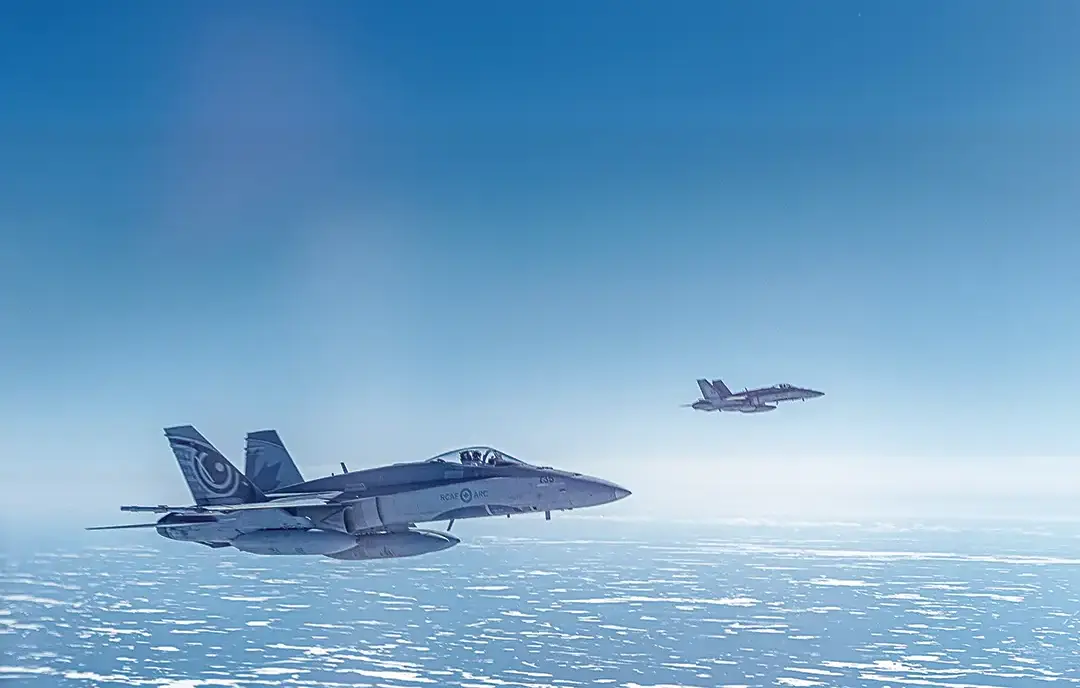
The North American Aerospace Defense Command (NORAD), a Canada-U.S. mutual defense entity, has intercepted Chinese and Russian military aircraft conducting exercises in Alaska’s air defense identification zone.
Iceland, too, is shoring up security capabilities. Under a policy adopted in September 2025, Reykjavik will increase domestic preparedness and cooperation with multinational groups such as NORDEFCO. “Iceland’s remote location, distance and isolation no longer suffice against external threats; they are, instead, creating specific challenges,” the International Institute for Strategic Studies, a London-based think tank, reported in November 2025.
The Arctic’s NATO countries are concerned about China’s growing knowledge of undersea conditions, which could benefit submarine deployments, military experts say.
China’s Arctic Ambitions
Beijing’s portrayal of its involvement in the Arctic as a win-win for itself and other states is becoming more difficult to accept as its relationship with the West sours and its ties with Russia grow, the Wilson Center, a U.S.-based research institute, reported in August 2024. Beijing and Moscow increasingly are linked in Arctic matters, especially since their leaders declared a “no-limits” strategic partnership days before the Kremlin’s war against Ukraine began. But the authoritarian regimes have different outlooks: While Russia aims to divide other Arctic nations, China seeks to join and influence.
While China’s actions in the Arctic warrant attention, Russia remains the most potentially troublesome actor, observers say. It’s important not to overestimate Beijing’s regional clout, Lajeunesse said. “We have a tendency to treat the Chinese as though they’re a great Arctic power. They’re not.”
With many of its Arctic ambitions unfulfilled, China is focused on steadily building its capacity to operate in the region and using soft power, from economic investments to science diplomacy, to fashion itself as a legitimate stakeholder, the U.S.-based Rand Corp. research group reported in February 2025.
China’s dual-use endeavors are obvious, Eiterjord, of The Arctic Institute, wrote in The Diplomat magazine in April 2025. Under the Chinese Communist Party’s strategy of military-civil fusion, the shipyards that build the nation’s cargo fleet also underpin its rapidly expanding navy, while many of the country’s designers of research vessels also develop its warships.
Satellites, robotic arms and launch systems can serve commercial and military purposes, a U.S. congressional committee reported in November 2025. Unclear distinctions between China’s state-owned enterprises and its nominally private firms add to the confusion.
Among 64 research and survey vessels deployed on Chinese oceanographic missions worldwide since 2020, more than 80% “demonstrated suspect behavior or possess organizational links suggesting their involvement in advancing Beijing’s geopolitical agenda,” the Center for Strategic and International Studies (CSIS), a U.S.-based policy research group, reported in 2024. Many of the ships operated in the South China Sea and the Western Pacific.
Beijing insists the China-Iceland Joint Arctic Science Observatory near Akureyri, Iceland, and the Yellow River Station, a research outpost in Svalbard, Norway, are purely scientific ventures, but the operations have raised speculation about ulterior motives, The Arctic Institute reported in October 2025.
Much of China’s Arctic effort is aimed at developing the Northern Sea Route (NSR) atop Asia for international shipping and acquisition of oil, natural gas, minerals and fish. The undertaking entails collaboration with Russia, and both regimes benefit from an increasingly accessible channel. But Beijing and Moscow differ in their characterization of the Arctic and its maritime passages. While China has called the Arctic the “common heritage of humankind,” Russia, with more than half of the Arctic coastline, takes a possessive stance, insisting it’s the domain of Arctic states.
China provided Russia with a range of goods via the NSR in 2024, including chemicals, construction materials, automobiles and clothing, the U.S. congressional committee reported. Meanwhile, Russian exports to China via the NSR were mostly crude oil and liquefied natural gas, shipments that violate international sanctions against Moscow but help Russia find markets for its energy resources while providing China with inexpensive fuel.
The partnership between China and Russia, especially their military overflights and naval exercises on the polar region’s fringes, concerns Arctic nations. “Strategic competition is one thing, but the flexing of military muscles is a major escalation in tension,” The Arctic Institute reported.