ROK successfully tests hypersonic missile
FORUM Staff
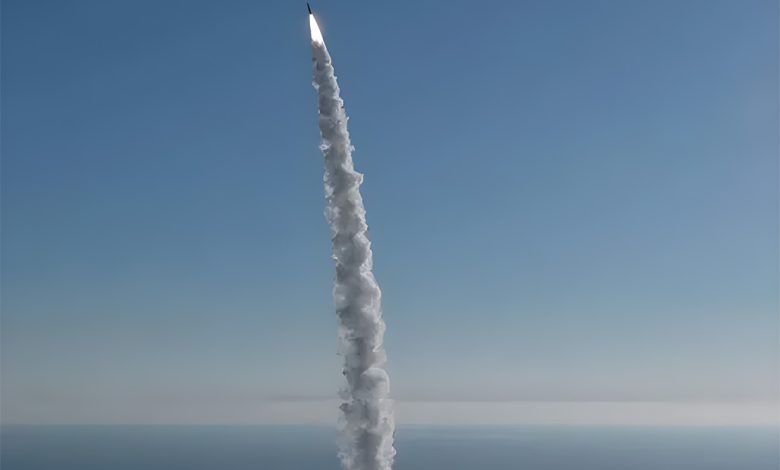
The Republic of Korea (ROK) launched its first domestically built hypersonic glide vehicle (HGV) in October 2026, joining the handful of Indo-Pacific countries operating or developing hypersonic missile capabilities.
The successful trial came days after North Korea reportedly test-fired a medium-range hypersonic missile and less than three weeks after land mine explosions near the nations’ border injured three ROK Soldiers, increasing tensions on the Korean Peninsula.
Hypersonic weapons travel at five times the speed of sound, about 6,100 kilometers per hour, and their unpredictable flight patterns make them more difficult to detect and destroy than conventional ballistic missiles.
There are two types of hypersonic missiles: engine-propelled cruise missiles and HGVs. Both fly on trajectories lower than high-arching ballistic missiles and can carry conventional or nuclear warheads.
ROK President Lee Jae-myung and Defense Minister Kang Shin-chul attended the HGV launch, the latest phase of a research and development project that employs domestic technology. The ROK “must secure our security through our own strength,” Lee said, according to The Associated Press.
The test missile separated from its rocket booster in the upper atmosphere and glided toward a maritime target, Singapore’s CNA news agency reported. The flight verified “the performance of ultra-high-temperature heat-resistant materials — a core technology for glide vehicles — as well as guidance and control capabilities and the ability to fly irregularly at low altitudes under hypersonic flight conditions,” Lee’s office stated.
The HGV is a key strategic asset that offers “a new deterrence capability capable of striking key targets within the Korean Peninsula’s operational environment,” according to the statement.
Lee also inspected the ROK’s Hyunmoo-5 surface-to-surface ballistic missile, dubbed the “monster missile” for its massive weight and destructive power, the Yonhap news service reported.
— STORY CONTINUES BELOW —
Join the discussion
How does your nation support international efforts to deter North Korea’s illicit military buildup?
South Korea and North Korea technically have remained at war since fighting in the three-year Korean War ended with an armistice in 1953. Recent incidents have raised tensions, including the September 2026 explosion of land mines in the peninsula’s Demilitarized Zone (DMZ).
Seoul said North Korean personnel placed the devices on the ROK side of the border within the 4-kilometer-wide DMZ that separates the countries.
China and Russia have hypersonic weapons, and India and Japan are among Indo-Pacific nations developing and testing the technology. The United States, the ROK’s longtime ally, deployed its Dark Eagle Long-Range Hypersonic Weapon for testing during Exercise Valiant Shield in Guam in June 2026.
Australia, as part of increased defense collaboration with Japan, will allow Tokyo to test-launch hypersonic missiles from its ranges. Meanwhile, Allies and Partners are developing technologies to detect, track and eliminate hypersonic weapon threats.
Some analysts contend the speed, accuracy and maneuverability of HGVs will fundamentally change warfare, a U.S. Congressional Research report stated in May 2026.