Japan’s proposed defense budget calls for more drones, AI, missiles
The Associated Press
Japan plans to incorporate drones, artificial intelligence (AI) and other emerging technologies as it adapts its defense strategies, according to a $55.6 billion annual budget request.
The preliminary total, announced by Japan’s Defense Ministry in August 2026, is expected to increase after the government approves a security strategy to strengthen Japan’s counterstrike capabilities.
Japan has doubled its defense spending to about 2% of gross domestic product under a five-year strategy adopted in 2022. The nation is building its Self-Defense Forces’ role to counter China’s growing assertiveness.
Tokyo aims to “drastically strengthen its deterrence and response capability” by adapting to new types of warfare as seen in Ukraine’s deployment of drones, the Defense Ministry said.
The ministry said that requires domestic development and mass production of low-cost uncrewed weapons to control expenses, minimize casualties and build a more cost-efficient air defense network. It plans to use drones in coordination with long-range missiles as counterstrike options, including underwater-launched uncrewed systems.
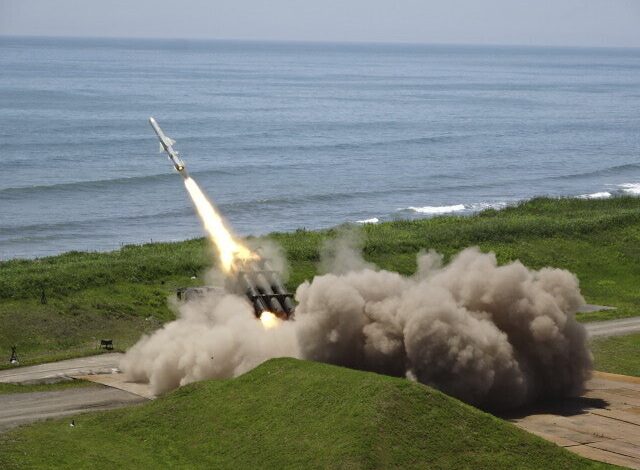
Japan has fortified its southwestern region with longer range missiles and interceptors. To further strengthen counterstrike capabilities, the Defense Ministry is seeking to develop submarine-launched hypersonic missiles.
The ministry also plans to introduce an integrated AI platform in command and control to improve speed and accuracy in decision-making, including assessing battlefields and choosing targets.
Japan is considering using existing foreign AI technologies, including those from its longtime ally, the United States, while also developing and strengthening domestically developed AI, officials said.
The Defense Ministry wants to develop an “AI orchestrator” platform to integrate multiple systems. It also plans to build a cloud computing system for sensitive data transmission and stable communications networks in an emergency.
The budget request includes funding to support companies’ defense-related research and development or restructuring to strengthen production and efficiency.