
Strategy of Denial
Information operations can support and amplify credible deterrence

Maj. Gen. Paul Kenny/Australian Defence Force
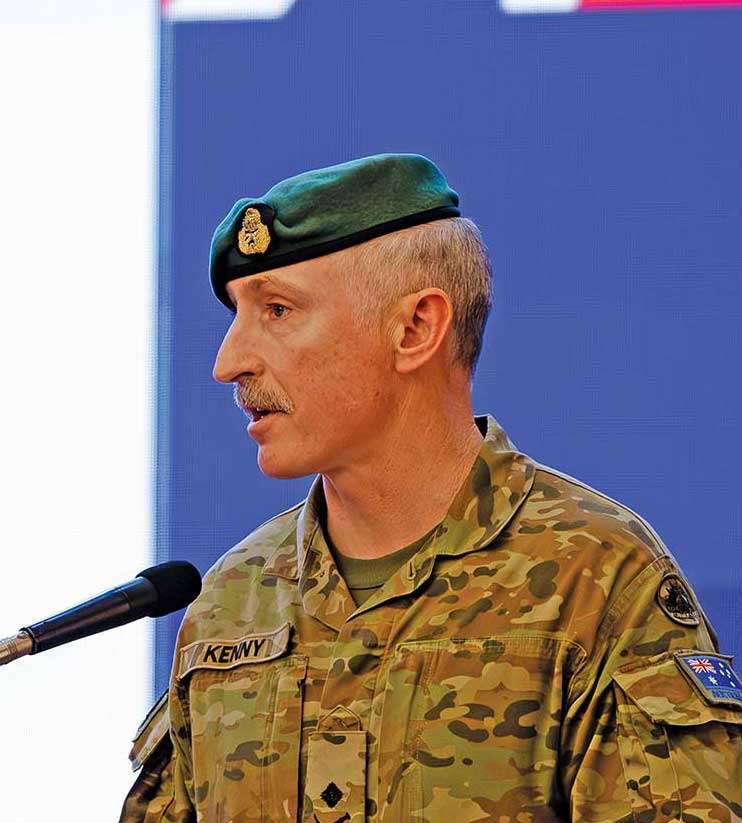
Maj. Gen. Paul Kenny
AUSTRALIAN DEFENCE DEPARTMENT
Australia’s strategy of denial, adopted under the National Defence Strategy (NDS) released in 2024, aims to deter conflict, prevent any potential adversary from coercing Australia through force, support regional security and prosperity, and uphold a favorable regional strategic balance.
This strategy rests on signaling “a credible ability to hold potential adversary forces at risk” in order “to deter attempts to coerce Australia through force,” according to the NDS.
Information operations (IO) can include signaling, enhancing operations through the information environment to amplify deterrent effects. Without it, we might conduct activities that we believe deter without achieving the effect we seek. Signaling makes deterrence effects credible to the recipient and supports those effects to be comprehended through a strong narrative — on which actions must deliver or become a bluff or deception. Tailoring the narrative, wherever possible, ensures the recipient interprets the signals as intended.
We must use IO to signal that we possess the capacity, determination and willingness to achieve deterrence. Changes to posture and presence are inadequate without clear signaling, including through IO that demonstrate our willingness to counter, defend and expose.
The Australian Defence Force (ADF) — as the military instrument of national power — is a core part of the NDS. The ADF’s primary contribution is “hard power” that deters actions against Australia’s interests. However, the ADF also supports effects used to shift an actor’s decision calculus. We are the only element that can provide a hard power option for government. We are by no means the only element that can have an information effect and, for that reason, we must integrate with all instruments of national power. Similarly, we know that working with Allies and Partners will amplify our deterrence signaling.
Amplifying Deterrence
The first element of IO is strategic messaging. Effectively communicating what we can and will do, and why, is critical to establishing our credibility. IO supporting a deterrent effect should underscore that our military capability is designed to preserve and promote peace, even though it provides options across the spectrum of power. Successful deterrence also requires that strategic messaging contain an element of assurance.
The second element of IO is the need to call out behavior that might challenge regional peace and prosperity. We live in a world where disinformation, propaganda and coercive messaging are the norm. The rise of artificial intelligence tools and the proliferation of disinformation on social media have accelerated this trend. The value we place on individual freedom means these false narratives threaten our citizens. We have a responsibility to present transparent, fact-based information to counter disinformation and expose the actions of those who work against our interests.
The final element is IO as a force multiplier. IO extend the effects of hard power by shaping perceptions, influencing decision-making and degrading adversary cohesion, long before the first shot is fired. When integrated with combat forces, IO capabilities enhance the impact of hard power by amplifying the credibility of deterrent messaging, countering propaganda and ensuring that our narrative dominates the information environment.
At the tactical and operational levels, IO forces provide commanders with tools to shape the information environment in real time. They enable units to disrupt enemy command and control through electronic warfare, expose adversary deception, and safeguard decision-making processes by protecting critical information channels. In the past, combining arms of war focused on including artillery or naval surface fire support to suppress or isolate adversary formations. Today, combining arms includes IO to neutralize adversary influence, disrupt their freedom of action in the information domain and preserve the initiative for friendly forces. By synchronizing IO, cyber capabilities and electronic attack with maneuver and fires, commanders can disrupt a potential adversary.
Future Deterrence
Credible deterrence demands constant monitoring and evaluation. It requires clear messaging that signals hard power effects for purposes of deterrence, provides assurance, enhances ally and partner integration, and helps citizens and regional partners see our actions and the principles we defend.
IO are not an optional extra but an enabler of each of these pillars — sharpening signals, exposing malign behavior and strengthening resilience to disrupt a potential adversary’s chances of success. As we build integrated IO capabilities across our military and with partners, we must uphold the high standards of ethical, lawful and transparent use of these tools so they reinforce, rather than corrode, the values we protect.
We should accelerate investment in training, interoperability and joint exercises, and shared doctrine that combine hard power with IO. By doing so, we will make deterrence more credible and comprehended with our collective forces. Our joint resolve will be the signal to any would-be coercer that the risks of aggression far outweigh any possible gains.
Maj. Gen. Paul Kenny, the Australian Defence Force’s deputy theater commander, Joint Operations Command, delivered this presentation at the United States Indo-Pacific Command in Hawaii in October 2025. It has been edited to fit FORUM’s format.