Taiwan to acquire, develop drones to strengthen defense, boost exports
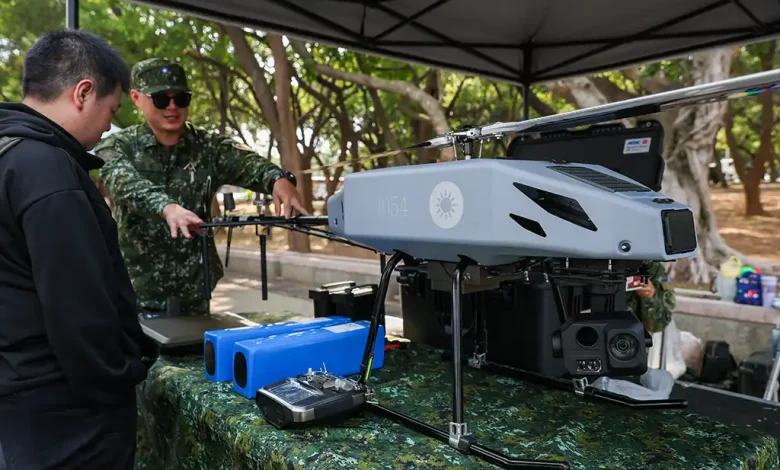
Taiwan is investing in autonomous systems, including aerial and sea drones, that have been used widely in the Russia-Ukraine and Iran conflicts. Taiwan recently approved a $7.4 billion drone defense bill, and its military wants to acquire more than 1,400 coastal surveillance and reconnaissance drones, 200,000 attack drones, and 1,320 one-way attack uncrewed surface vessels (USV), the Agence France-Presse (AFP) news agency reported.
Taiwan officials, defense researchers and international companies highlighted the growing importance of uncrewed maritime systems, super intelligence — also known as artificial intelligence — and domestic defense manufacturing during a sea drone exhibition in Taipei in late October 2026. The event showcased how sea drones can monitor around Taiwan, a self-governed island that the Chinese Communist Party threatens to annex by force.
Taipei is prioritizing developing uncrewed systems technologies for economic and strategic reasons. It seeks to supply trusted uncrewed systems to international partners while strengthening Taiwan’s ability to defend itself.
To become a top drone exporter, Taipei must establish three pillars to a domestic industry, officials said at the Taiwan Drone International Forum: forge supply chains that do not involve China; develop and integrate super intelligence into autonomous platforms such as uncrewed aerial vehicles (UAV) to allow decision-making and navigation even during jamming attempts; and finalize international partnerships to allow joint research and development, technology transfers, and collaborative manufacturing.
Demand is spurring the effort. Taiwan exported about 210,000 drones worth $237.6 million between January and July 2026, already surpassing its 2025 total, the Taipei-based CommonWealth Magazine reported.
Taiwan has the expertise and industrial foundation to manufacture sea drones, analysts say, noting electronics manufacturers, precision-machinery suppliers, and motor producers and manufacturers can produce uncrewed systems. Taiwan also is seeking partners to produce battle-tested systems with enhanced software. For instance, the Taiwan Coast Guard plans to buy 25 USVs from United States-based Maritime Tactical Systems that will be manufactured in Taiwan and the U.S.
“If you’ve got a lot of small USVs out there doing a lot of different missions, it really takes a load off of the Coast Guard and the Navy and what some of their gray hull ships are doing,” company executive Seamus Flatley told AFP.
Sea drones, which can be built faster than a warship or submarine, are a relatively low-cost asset that can complicate an adversary’s plans. Global interest in uncrewed underwater vehicles also has soared since the Middle East conflict began in February 2026.
“We have seen a significant increase in demand as people start to realize that you can just have a very simple mine destroy a whole entire [maritime] channel, and that’s where underwater robots come in to neutralize these targets,” Grace Chia, chief executive of BeeX, an autonomous underwater vehicle manufacturer in Singapore, told AFP.
The drone forum coincided with the opening in Taipei of the Global UAV Academy, a nongovernmental agency designed as a hub for training, technical certification and production. Officials said the initiative will connect industry, government, academia and research institutions, making Taiwan’s drone efforts more flexible and integrated.
The academy has signed cooperation and training agreements with the Japan Drone Consortium, Palau Community College, the Polish Chamber of Unmanned Systems, Taiwan’s National Chung-Shan Institute of Science and Technology — a military research and development center — and the U.S.-based Association for Uncrewed Vehicle Systems International.